Roof Overlay vs Replacement Pennsylvania: What You Need to Know
When it’s time for a new roof, many Pennsylvania homeowners are offered a choice they weren’t expecting: a “roof overlay” — laying new shingles directly on top of the existing layer — versus a full tear-off and replacement. The overlay is often presented as a money-saving shortcut. In some narrow circumstances it is appropriate. In most situations across Bucks County, it is a decision you will regret within ten years.
At YBR GROUP Inc, we’ve been doing full roof replacements in Warminster, Doylestown, Newtown, Levittown, and throughout Bucks County since 2016. We want you to understand exactly what you’re choosing — and what you’re giving up — before you sign a contract.
What Is a Roof Overlay?
A roof overlay (also called a re-roof or second layer) means new shingles are nailed directly over the existing shingle layer without removing the old material first. There is no tear-off, no debris disposal, and no inspection of the underlying roof decking.
The appeal is straightforward: you skip the labor cost of tearing off the old shingles and disposing of them. An overlay can save [ESTIMATED — verify with contractor] $1,500–$3,000 in labor and disposal costs on a typical Bucks County residential roof compared to a full tear-off. That is a real savings — if the overlay is actually appropriate for your situation.
Pennsylvania Code Limits: The Two-Layer Rule
Under the Pennsylvania Uniform Construction Code (PA UCC), which adopts the International Residential Code (IRC), residential structures are permitted a maximum of two roofing layers [Source: International Residential Code, Section R905.1.1]. This means:
- If your home currently has one shingle layer, an overlay is code-compliant (with other conditions met)
- If your home already has two layers, a full tear-off to bare decking is required before any new roofing can be installed
- A contractor installing a third layer violates the PA UCC, voids virtually every manufacturer warranty, and can create liability for the homeowner
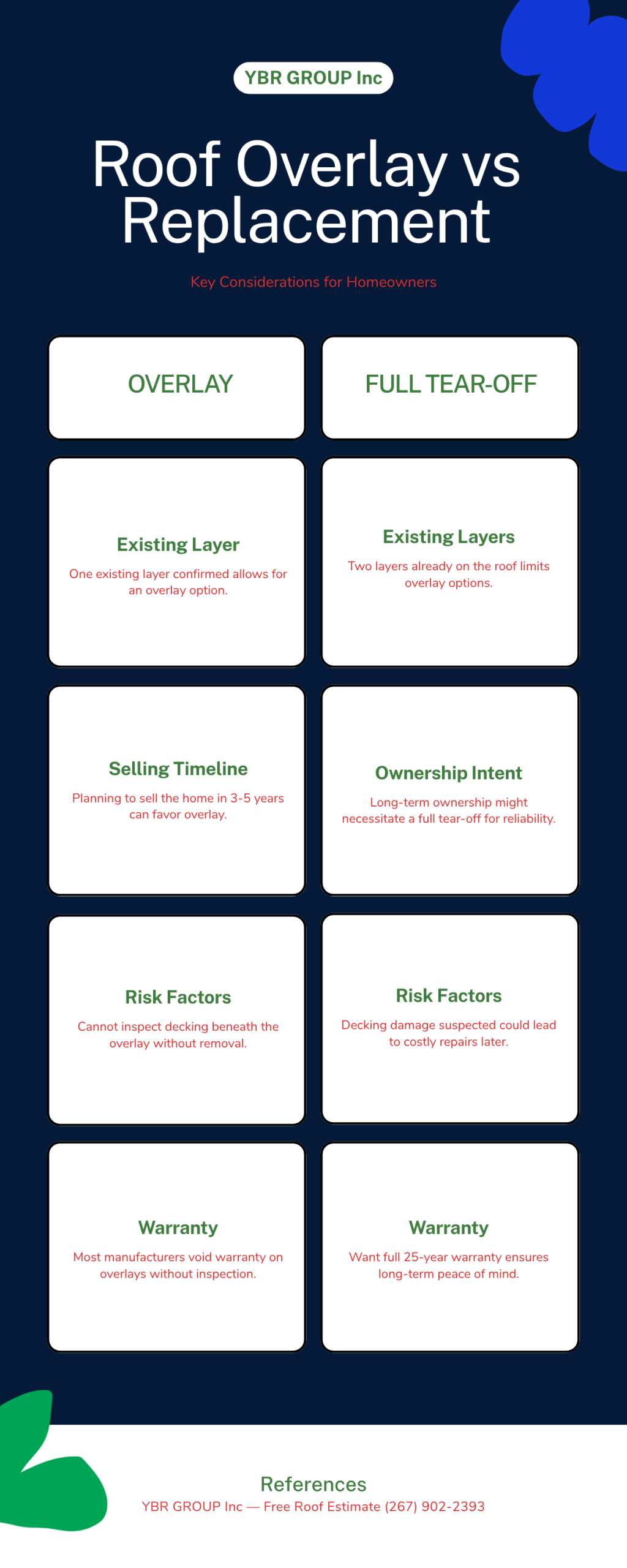
Many Bucks County homes built in the 1970s–1990s have already had one overlay. Before accepting an overlay bid, ask the contractor explicitly: how many layers are currently on this roof? If the answer is already two, the conversation is over — you need a full tear-off.
The Hidden Problems with Roof Overlays
Even when a second layer is code-compliant, overlays carry significant technical drawbacks that most contractors presenting the overlay option do not explain in full:
1. You cannot inspect the decking. The single most important element of any new roof installation is the condition of the roof decking — the OSB or plywood substrate the shingles fasten to. Soft spots, rot, mold, delamination, and structural damage are common in Bucks County homes that have experienced prior leaks or inadequate attic ventilation. None of this is visible or accessible with an overlay. You are nailing new shingles to a substrate you cannot evaluate — and paying for a 25-year roof that may be fastened to decking that will fail in 7.
2. Ice and water shield cannot be properly installed. Pennsylvania’s UCC and all major shingle manufacturers require ice and water shield — a self-adhering waterproof membrane — at the eave, in valleys, around penetrations, and at other vulnerable areas. This shield must be adhered directly to clean, dry roof decking to function. Applying it over existing shingles renders it ineffective, which means your overlay roof has inadequate protection against the ice dams and driving rain that Bucks County winters regularly produce.
3. Most manufacturers void warranties on overlays. GAF, Owens Corning, CertainTeed, and virtually every major shingle manufacturer either prohibit overlay installation for warranty coverage or require specific conditions that are difficult to meet in practice [Source: GAF Residential Roofing Installation Manual; Owens Corning Shingle Warranty Terms]. The 25–30 year warranty you believe you’re purchasing may not be in effect at all on an overlay installation. Read the warranty documentation before accepting an overlay bid.
4. Shorter lifespan — 20–30% reduction. Multiple layers of shingles trap heat. The new top layer runs significantly hotter than it would over bare decking and proper underlayment, accelerating asphalt degradation. Industry estimates suggest overlays reduce shingle lifespan by 20–30% compared to a clean installation [ESTIMATED — verify with roofing manufacturer technical data]. A 25-year shingle may realistically last 15–18 years as an overlay in Pennsylvania’s summer heat.
5. Added weight — structural load concerns. A layer of asphalt shingles weighs approximately 200–340 lbs per square (100 sq ft). Adding a second layer adds that weight to the roof structure. For most modern Bucks County homes with standard roof framing, this is within design tolerances. For older homes — particularly the 1950s–1960s Levittown-era construction — or homes with any pre-existing framing concerns, the additional 2–4 lbs per square foot of load warrants a structural assessment before proceeding.
6. Unevenness compounds over time. Old, curled, or buckled shingles telegraph through the new layer. The overlay roof looks acceptable on installation day and progressively uneven as the substrate shingles continue to deteriorate underneath. Resale inspectors note this clearly.
When Is an Overlay Actually Appropriate?
There are legitimate scenarios where an overlay is a reasonable short-term decision:
- The existing single layer is in structurally sound, flat condition (no curling, no buckling, no known deck damage)
- The homeowner has a defined short-term horizon — selling within 3–5 years, for example — and needs a presentable roof without a full replacement investment
- Budget constraints are severe and the alternative is deferred maintenance on a failing roof
- The current layer is confirmed to be the first and only layer
Even in these cases, be explicit with any buyer’s inspector and disclosure form about the overlay condition. In Pennsylvania real estate transactions, seller disclosure of known roof conditions is required under the Real Estate Seller Disclosure Law.
Full Tear-Off: Why It’s Almost Always the Better Long-Term Choice
A full tear-off and replacement:
- Exposes the decking for full inspection and repair of any damaged sections
- Allows proper installation of ice and water shield at all required locations
- Activates the full manufacturer material warranty
- Allows proper starter strip and drip edge installation
- Provides the full rated lifespan of the new shingles
- Eliminates the weight of the old layer
- Gives you the actual 25–30 year roof you’re paying for
The additional cost [ESTIMATED — verify with contractor] of $1,500–$3,000 over an overlay, amortized across a 25–30 year roof lifespan, is roughly $50–$100 per year. Against the risk of decking failure, warranty voidance, and a shorter-lived roof that you’ll replace 7–10 years sooner, the tear-off almost always wins on total cost of ownership.
YBR GROUP performs full tear-off replacements as our standard — not because it’s more work for us, but because it’s the only way to deliver a roof we’re willing to warranty our own workmanship on.
Frequently Asked Questions
Is a roof overlay legal in Pennsylvania?
Yes — a single overlay (second layer total) is permitted under the Pennsylvania Uniform Construction Code, which follows the International Residential Code. A third layer is not permitted. The overlay must also meet manufacturer installation requirements for the new shingles being installed, which many manufacturers restrict or prohibit for warranty coverage. Code-compliant does not mean problem-free.
Will a roof overlay void my shingle warranty in Pennsylvania?
Most major manufacturers (GAF, Owens Corning, CertainTeed) either exclude overlays from full warranty coverage or impose significant restrictions. Some offer limited “base” warranties on overlays but exclude wind and algae coverage. Read the specific warranty documentation for the product being installed. When a contractor presents an overlay, ask them in writing: “What warranty coverage will I have under the manufacturer’s terms for an overlay installation?” If they cannot answer specifically, treat that as a red flag.
How much does a full roof tear-off add to the cost in Bucks County?
The additional cost for tear-off and disposal versus an overlay is [ESTIMATED — verify with contractor] typically $1,500–$3,000 for a standard Bucks County residential roof, depending on square footage, number of existing layers being removed, and current disposal costs. For a 2,000 sq ft roof, this premium is approximately $0.75–$1.50 per square foot. Given the manufacturer warranty implications and extended lifespan of a clean installation, the tear-off premium is recovered in most cases well within the roof’s first decade.
Does a roof overlay affect my home’s resale value in Pennsylvania?
Yes, in two ways. First, a buyer’s home inspector will identify and note an overlay in their report, which experienced buyers treat as a flag for deferred maintenance. Second, Pennsylvania’s Real Estate Seller Disclosure Law (68 P.S. § 7301 et seq.) requires disclosure of known material defects — and a two-layer roof that is nearing end of life is a condition you are obligated to disclose. A full tear-off and replacement provides clean disclosure and eliminates the negotiation leverage an overlay creates.
Not sure whether your Bucks County home qualifies for an overlay or needs a full tear-off? YBR GROUP Inc provides honest assessments with no upsell pressure. We’ll tell you exactly how many layers are on your roof, the condition of your decking (if accessible), and which option makes financial sense for your situation.
Call (267) 902-2393 for a free roof estimate — serving Warminster, Doylestown, Newtown, Levittown, Southampton, Holland, and Lower Makefield. Visit our roofing services page for full details on our replacement process.
">