Asphalt Shingle Types in Bucks County PA: 3-Tab vs Architectural vs Designer
Choosing the right asphalt shingles for your Bucks County home is one of the most consequential decisions you’ll make as a homeowner — it affects curb appeal, energy performance, insurance premiums, and how well your roof survives the next nor’easter. With three distinct product tiers on the market, and Pennsylvania’s climate demanding more than the national average, understanding what separates 3-tab, architectural, and designer shingles can save you thousands of dollars and years of headaches.
At YBR GROUP Inc, we’ve been installing and replacing roofs across Bucks County since 2016 — from Warminster ranch homes to Doylestown colonials to Newtown estates. Here is what you actually need to know before you pick a shingle.
What Are Asphalt Shingles and Why Do They Dominate Pennsylvania Roofing?
Asphalt shingles account for roughly 80% of all residential roofing in the United States [Source: Asphalt Roofing Manufacturers Association (ARMA)]. In Pennsylvania — and specifically across Bucks County communities like Southampton, Holland, and Lower Makefield — asphalt dominates because it offers the best balance of cost, wind performance, and ease of installation in a Mid-Atlantic climate that sees everything from summer heat and humidity to winter ice dams and spring hail.
All asphalt shingles share the same basic construction: a fiberglass or organic mat core, asphalt coating for waterproofing, and mineral granules on top for UV protection and aesthetics. What separates the three tiers is weight, dimensional depth, wind resistance, and lifespan.
3-Tab Shingles: The Entry-Level Option
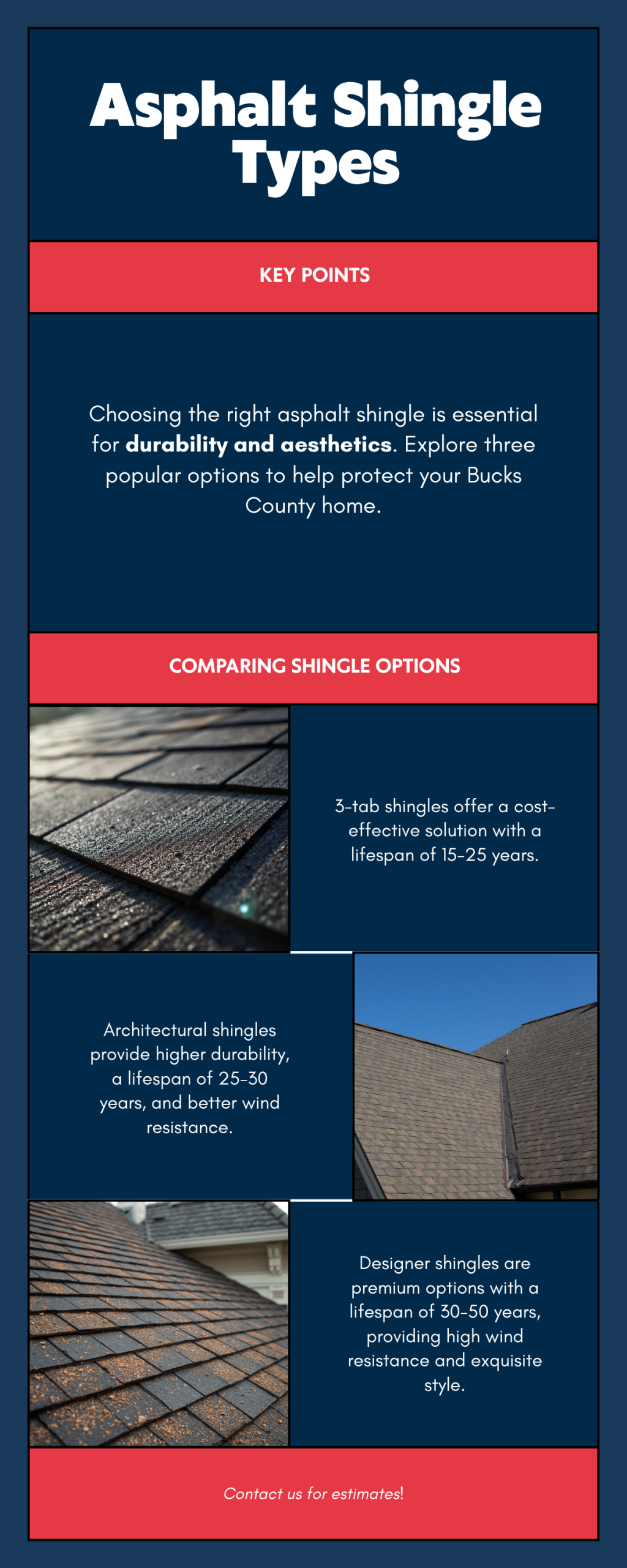
Three-tab shingles are the thinnest and flattest option. Named for the three uniform cutouts along the lower edge that give the appearance of three separate shingles, they were the standard across most of Bucks County through the 1990s and into the early 2000s.
Key specifications:
- Lifespan: 15–25 years under normal conditions
- Wind rating: 60–70 mph (standard)
- Weight: Approximately 200–225 lbs per square (100 sq ft)
- Cost: [ESTIMATED — verify with contractor] Lowest of the three tiers; roughly 20–30% less material cost than architectural
The core limitation for Bucks County homeowners is wind resistance. A 60–70 mph wind rating is inadequate for the nor’easters that regularly track up the I-95 corridor and put the Delaware Valley in the bullseye. Pennsylvania Insurance Department data shows wind is the leading cause of residential roof claims in the state. If you are in an exposed location — think a hilltop in Doylestown Township or a corner lot in Warminster — 3-tab shingles represent genuine risk.
Most major manufacturers have reduced or discontinued their 3-tab lines as architectural shingles have dropped in price. Today, 3-tab makes sense primarily for budget-constrained rentals or accessory structures where aesthetics and longevity are secondary concerns.
Architectural (Dimensional) Shingles: The Pennsylvania Standard
Architectural shingles — also called dimensional or laminated shingles — are now the dominant product installed across Pennsylvania and represent the baseline recommendation for virtually every Bucks County home. They are constructed with two bonded layers of asphalt material, creating a three-dimensional appearance that mimics the look of wood shake or natural slate at a fraction of the cost.
Key specifications:
- Lifespan: 25–30 years (manufacturer warranty) with proper installation and ventilation
- Wind rating: 110–130 mph standard; some lines carry Class F (110 mph) certification
- Weight: Approximately 240–340 lbs per square
- Cost: [ESTIMATED — verify with contractor] Moderate premium over 3-tab; widely available from Owens Corning, GAF, CertainTeed, and others
The wind performance jump is the headline. A Class F wind rating — which many architectural lines now achieve — provides meaningful protection during the nor’easters and remnant tropical systems that affect Lower Makefield, Holland, and other exposed Bucks County communities. For homeowners seeking insurance discounts, Class F certification is often a qualifying criterion.
Algae resistance is a critical feature in the humid Mid-Atlantic climate. Look for shingles with copper or zinc granules embedded in the surface coating — these inhibit the blue-green algae that creates dark streaking (often mistaken for dirt) across Pennsylvania roofs within 5–10 years of installation. Most premium architectural lines include algae-resistant granules as standard.
Class 4 impact resistance is a separate optional upgrade worth serious consideration in Bucks County. The region sits in a moderate-to-high hail frequency corridor, and Class 4 shingles (the highest UL 2218 rating) can qualify homeowners for meaningful insurance premium reductions — often enough to offset the cost premium over a 10-year horizon [Source: Insurance Institute for Business & Home Safety (IBHS)].
Designer Shingles: Premium Performance and Aesthetics
Designer shingles — sometimes called luxury or premium shingles — are the top tier of the asphalt category. They are engineered to replicate the appearance of natural slate, cedar shake, or Spanish tile using extra-thick laminated asphalt construction. In Doylestown’s historic district and Newtown’s established neighborhoods, where architectural character matters and HOA guidelines may restrict roofing aesthetics, designer shingles offer a compliant, low-maintenance alternative to genuine slate.
Key specifications:
- Lifespan: 30–50 years depending on product line and installation conditions
- Wind rating: 110–130 mph standard; some lines exceed 150 mph
- Weight: 350–450+ lbs per square — structural assessment recommended for older homes
- Cost: [ESTIMATED — verify with contractor] Significant premium over architectural; typically 2–3x material cost
The aesthetic difference is substantial. Products like GAF Camelot II, Owens Corning Berkshire, and CertainTeed Grand Manor deliver a genuinely slate-like shadow line and irregular tab profile that reads from the street as a premium material. For Bucks County homes where resale value and neighborhood comparables matter, the upgrade often pencils out over a 20-year ownership horizon.
Wind Ratings, Impact Ratings, and What They Mean for Bucks County
Pennsylvania’s climate makes performance ratings non-optional information:
- Class F Wind Rating (ASTM D3161): Resists 110 mph wind-driven rain — the minimum target for any exposed Bucks County location.
- Class 4 Impact Rating (UL 2218): The highest hail-resistance rating. A 2-inch steel ball dropped from 20 feet cannot crack the shingle. Qualifies for insurance discounts in many policies.
- Algae Resistance (ASTM D3274 / manufacturer certification): Copper or zinc granule treatment. Look for at least a 10-year algae-resistance warranty in the humid Delaware Valley microclimate.
Nor’easters specifically — the large winter cyclones that track up the Atlantic coast and produce sustained 50–80 mph gusts across Bucks County — have ended more 3-tab roofs prematurely than any other weather pattern in the region. Upgrading to an architectural or designer product with Class F certification is the single most impactful specification decision most homeowners can make.
Workmanship Warranty vs. Material Warranty: A Critical Distinction
Every shingle manufacturer provides a material warranty covering defects in the product itself — typically 25–50 years depending on tier. What most homeowners miss is that this warranty does NOT cover installation errors, and installation errors are the leading cause of premature shingle failure.
A workmanship warranty — provided by the contractor, not the manufacturer — covers labor defects for a defined period (commonly 2–10 years for standard contractors; some manufacturers offer extended workmanship coverage when a certified installer is used). At YBR GROUP, we stand behind our installations with a contractor workmanship warranty because we know Bucks County weather will test the work.
When comparing bids, always ask: Is this a manufacturer material warranty only, or does your company provide a separate workmanship warranty? The answer tells you a great deal about the contractor’s confidence in their own work.
Which Shingle Is Right for Your Bucks County Home?
Here is a practical decision framework:
- Budget replacement / accessory structure: 3-tab — but only in low-wind exposures and for structures where longevity is secondary.
- Standard residential replacement (most homes in Warminster, Levittown, Southampton): Architectural with Class F wind rating and algae-resistant granules. Add Class 4 impact if your insurer offers a discount.
- High-value homes, historic neighborhoods, or HOA contexts (Doylestown, Newtown): Designer shingles — the lifespan and aesthetic premium justify the cost when resale value and curb appeal carry weight.
- Any home with known hail history or exposed ridge lines: Class 4 architectural or designer — the insurance premium offset is real.
Frequently Asked Questions
How long do architectural shingles last in Pennsylvania’s climate?
Most architectural shingles carry a 25–30 year manufacturer material warranty. In Pennsylvania’s climate — which includes freeze-thaw cycles, summer UV exposure, humidity, and wind — realistic lifespan with proper attic ventilation and prompt repair of minor damage is typically 25–30 years. Poor ventilation is the leading cause of premature shingle failure in the Mid-Atlantic; trapped heat degrades the asphalt from below.
Do Class 4 impact-resistant shingles actually lower my insurance in Bucks County?
Many Pennsylvania home insurers offer premium discounts for Class 4 impact-resistant roofing. The discount varies by carrier — typically 5–30% on the dwelling coverage portion. Contact your insurer before purchasing to confirm their discount schedule and whether they require a third-party inspection or certificate. The discount can offset the Class 4 premium cost within 3–7 years for many homeowners.
What causes black streaking on asphalt shingles in Pennsylvania?
Black or dark gray streaking is caused by Gloeocapsa magma, a blue-green algae that feeds on the limestone filler in asphalt shingles. It is pervasive in Pennsylvania’s humid climate, particularly on north-facing roof sections and areas shaded by trees. Algae-resistant shingles with copper or zinc granules inhibit this growth. Existing streaking can be treated with diluted sodium hypochlorite (bleach) solution, though re-application is needed every few years without algae-resistant shingles.
Is a designer shingle worth the cost for a typical Bucks County home?
For most standard homes in Warminster, Levittown, or Southampton, architectural shingles provide the best value. Designer shingles make the most financial sense when: (1) the home is in a neighborhood where the upgrade maintains or improves resale comparables, (2) HOA requirements favor a premium aesthetic, (3) the homeowner plans a long-term hold and wants a 40–50 year solution, or (4) the home is replacing genuine slate or shake and matching the visual profile matters. YBR GROUP can walk you through the ROI analysis for your specific property.
Ready to choose the right shingles for your Bucks County home? YBR GROUP Inc has been serving Warminster, Doylestown, Newtown, Levittown, Southampton, Holland, and Lower Makefield since 2016. We carry architectural and designer lines from the industry’s top manufacturers and provide honest, no-pressure estimates.
Call us at (267) 902-2393 for a free roofing estimate. We’ll inspect your current roof, discuss your options across all three shingle tiers, and help you find the right product for your home, climate, and budget. Visit our roofing services page to learn more.