Energy Efficient Windows Pennsylvania: U-Factor, SHGC, and What Actually Matters for PA Homes
Walk into any window showroom in Bucks County and you’ll hear the same phrase: “energy-efficient windows.” But what does that actually mean — and which specs matter for a Pennsylvania home? This guide cuts through the marketing language to explain U-Factor, Solar Heat Gain Coefficient (SHGC), ENERGY STAR requirements for Climate Zone 4A, and what to actually look for when replacing windows in Warminster, Doylestown, Newtown, or anywhere else in Bucks County PA.
What Makes a Window Energy Efficient in Pennsylvania?
Energy efficient windows in Pennsylvania are defined by their ability to resist heat transfer in both directions: keeping warm air inside during cold Pennsylvania winters and blocking solar heat gain during humid summers. The two primary measurements that determine window energy performance are U-Factor and Solar Heat Gain Coefficient (SHGC).
Pennsylvania falls primarily in IECC Climate Zone 4A (mixed-humid), which creates a dual performance demand: windows must insulate against cold (low U-Factor) while moderating — but not completely blocking — solar heat gain (moderate SHGC).
U-Factor Explained: The Single Most Important Window Spec for PA Homeowners
U-Factor measures how readily a window conducts heat — how much heat moves through the entire window assembly (glass, frame, spacers) from one side to the other. The scale typically runs from 0.20 to 1.20 for residential windows.
- Lower U-Factor = better insulation
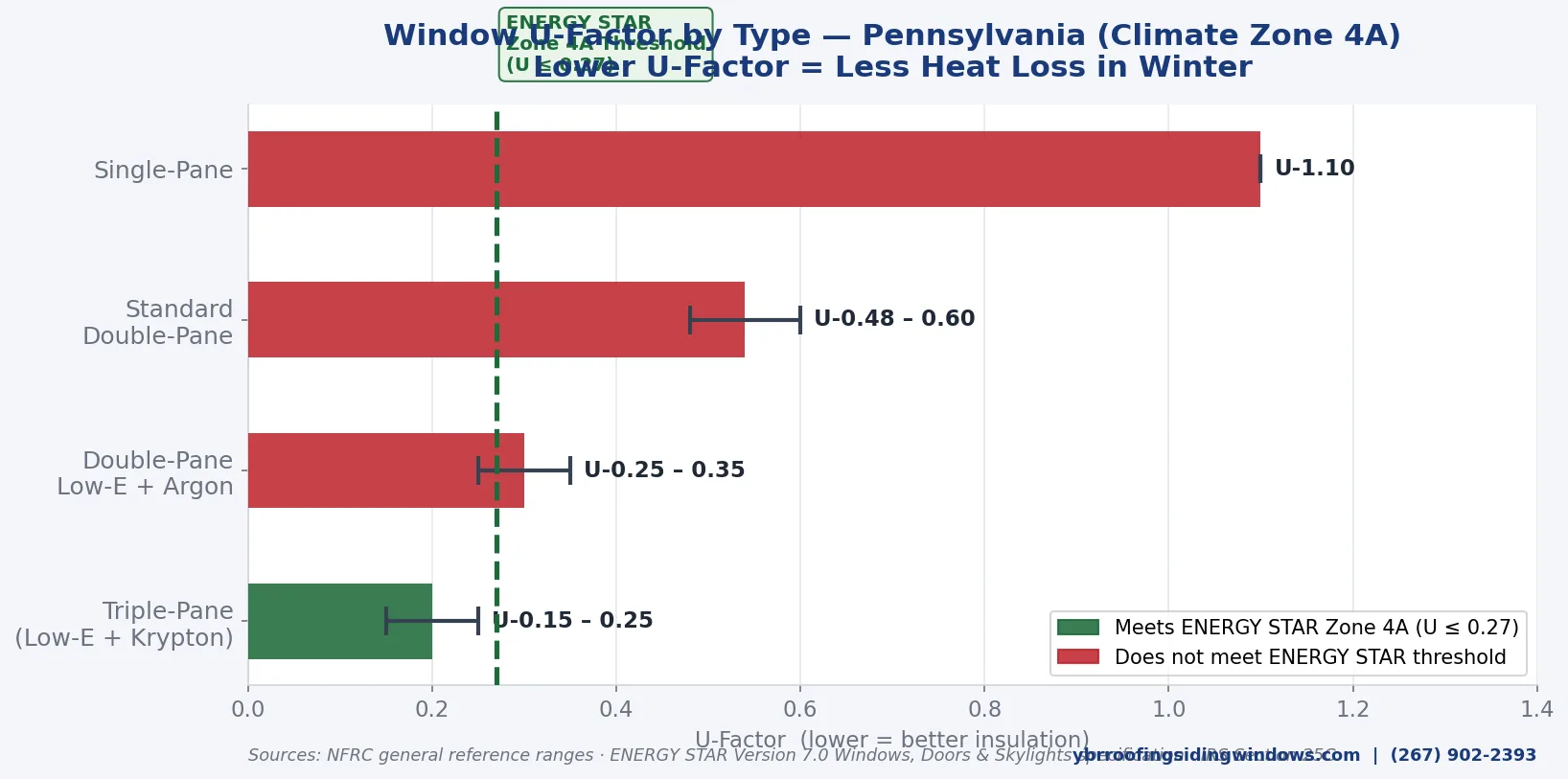
- Single-pane windows: U-Factor ~1.10 [Source: NFRC general reference ranges]
- Standard double-pane: U-Factor ~0.48–0.60 [Source: NFRC general reference ranges]
- Low-E double-pane: U-Factor ~0.25–0.35 [Source: NFRC/ENERGY STAR general reference ranges]
- Triple-pane: U-Factor ~0.15–0.25 [Source: NFRC general reference ranges]
For ENERGY STAR certification in Pennsylvania (Climate Zone 4A), windows must have a U-Factor ≤ 0.27 [Source: ENERGY STAR Version 7.0 Windows, Doors & Skylights specification; verify current requirements at energystar.gov].
For the federal Section 25C tax credit, the threshold is U-Factor ≤ 0.27 for Climate Zone 4 — the same as ENERGY STAR’s requirement for this zone [Source: IRS Energy Efficient Home Improvement Credit guidance].
SHGC Explained: Solar Heat Gain for Pennsylvania’s Climate Zone 4A
Solar Heat Gain Coefficient measures how much solar radiation passes through the window and into your home. The scale runs from 0 (no solar heat transmitted) to 1 (all solar heat transmitted).
- Lower SHGC = less solar heat entering the home
- Higher SHGC is beneficial in cold climates (free solar heating in winter)
- Lower SHGC is beneficial in hot climates (blocks summer heat)
Pennsylvania’s Zone 4A is mixed — cold winters benefit from solar gain; hot summers don’t. This is why the ENERGY STAR specification for Zone 4 sets SHGC ≤ 0.40 — a moderate restriction that allows meaningful winter solar gain while limiting summer overheating [Source: ENERGY STAR Version 7.0 specification].
For south-facing windows in Doylestown, Newtown, or Holland homes, a moderate SHGC of 0.25–0.35 often delivers the best year-round balance — enough passive solar heating in winter to reduce heating costs, without creating summer cooling load problems.
Low-E Glass: What It Does and Why It Matters in Bucks County
Low-emissivity (Low-E) glass is the technology that makes modern energy-efficient windows work. A microscopically thin metallic coating is applied to one or more glass surfaces, reflecting radiant heat back to its source.
- Hard-coat Low-E (pyrolytic): Applied during manufacturing; more durable but less effective than soft-coat. U-Factor typically 0.30–0.40.
- Soft-coat Low-E (sputtered): Applied in vacuum; more effective, typically U-Factor 0.20–0.30. Used in most premium ENERGY STAR windows for Zone 4A.
- Double Low-E: Coatings on multiple surfaces — used in triple-pane configurations targeting U-Factor below 0.20.
Low-E coatings also filter UV radiation, which reduces furniture and flooring fading. For homes in Warminster, Southampton, and throughout Bucks County with hardwood floors or valuable furnishings, UV protection is a meaningful secondary benefit.
Gas Fills: Argon vs. Krypton for Pennsylvania Homes
Most energy-efficient double-pane windows are filled with inert gas between the panes, which improves thermal performance over air.
- Argon gas: The standard fill for energy-efficient windows. Improves U-Factor by approximately 0.03–0.05 over air-fill [Source: NFRC general reference]. Cost-effective and widely available.
- Krypton gas: More effective than argon but significantly more expensive. Used in narrow-gap triple-pane windows where space constraints make argon less effective.
For most Bucks County PA homes replacing windows in 2026, argon-filled double-pane Low-E windows hitting U-Factor ≤ 0.27 represent the optimal performance-to-cost point. Triple-pane with krypton is worth considering for north-facing exposures or homes with extremely high heating bills [ESTIMATED guidance — discuss with contractor based on your specific home].
Frame Material and Energy Performance
The glass unit accounts for most of a window’s energy performance, but frame material matters too — especially in Pennsylvania’s climate extremes.
- Vinyl (uPVC) frames: Excellent thermal performance, low maintenance, competitive price. The most common frame material for window replacements in Bucks County PA. Insulated vinyl frames with multi-chamber construction perform best.
- Fiberglass frames: Similar or superior thermal performance to vinyl, more dimensional stability through temperature cycling, premium price. Well-suited to Pennsylvania’s freeze-thaw cycles.
- Wood frames (interior-clad): Good thermal performance, premium aesthetic. Aluminum or vinyl exterior cladding protects against Pennsylvania’s moisture and UV exposure.
- Aluminum frames: Poor thermal performance without thermal breaks. Not recommended as the primary frame material for energy-efficient windows in Zone 4A.
ENERGY STAR vs. ENERGY STAR Most Efficient: Which Do You Need?
Two tiers of ENERGY STAR certification apply to windows:
- ENERGY STAR Certified: Meets minimum criteria for the climate zone. For Zone 4A: U-Factor ≤ 0.27, SHGC ≤ 0.40. Qualifies for the IRS 25C tax credit.
- ENERGY STAR Most Efficient: Higher-performing products that exceed standard certification thresholds. For Zone 4A in 2026: U-Factor ≤ 0.20, SHGC ≤ 0.40 [Source: ENERGY STAR Most Efficient 2026 criteria — verify at energystar.gov as criteria are updated annually].
Most Efficient windows represent the top tier of available product and are worth considering for homes with high heating/cooling costs or where maximizing the 25C credit value matters. Standard ENERGY STAR certified windows are the appropriate baseline for most Bucks County window replacement projects.
EEAT: YBR GROUP’s Window Expertise in Bucks County PA
YBR GROUP Inc has been installing replacement windows for Bucks County PA homeowners since 2016 — in Warminster, Levittown, Doylestown, Newtown, Southampton, Holland, Lower Makefield, and surrounding communities. Our team helps homeowners match window specs to their home’s specific orientation, existing insulation levels, and energy goals. We install ENERGY STAR certified window products that meet 25C tax credit requirements and provide all necessary NFRC documentation at project completion. Every estimate includes a frank comparison of window options — not just the highest-margin product on the floor.
Frequently Asked Questions: Energy Efficient Windows in Pennsylvania
What U-Factor should I look for in replacement windows for a Bucks County PA home?
For most Bucks County homes in Climate Zone 4A, target a U-Factor of 0.27 or lower to meet ENERGY STAR certification and qualify for the IRS 25C tax credit. For maximum performance — especially on north-facing exposures or older homes with high heating bills — look for windows with U-Factor ≤ 0.20, which qualifies for ENERGY STAR Most Efficient designation.
Is triple-pane worth it for Pennsylvania homes?
Triple-pane windows offer U-Factors in the 0.15–0.22 range, compared to 0.25–0.30 for high-quality double-pane. In Bucks County PA’s Climate Zone 4A, the energy savings from triple-pane over double-pane are real but modest for most homes. Triple-pane is most cost-justified for north-facing exposures, homes with unusually high heating costs, or new construction where the incremental cost over double-pane is smaller. For replacement windows in an existing Bucks County home, the best double-pane Low-E argon units typically deliver the strongest ROI.
What is the difference between U-Factor and R-Value for windows?
R-Value and U-Factor are mathematical inverses: R-Value = 1/U-Factor. Windows are rated by U-Factor; insulation is rated by R-Value. A window with U-Factor 0.25 has an R-Value of 4. A window with U-Factor 0.20 has an R-Value of 5. U-Factor is the standard for windows because window assemblies (glass + frame + spacers) don’t perform like insulation batts — the U-Factor system accounts for the combined assembly performance more accurately.
Does window orientation matter for SHGC selection in Pennsylvania?
Yes, significantly. South-facing windows in Pennsylvania benefit from a moderate SHGC (0.25–0.40) to capture passive solar heating in winter — free heat during cold months. North-facing windows receive almost no direct solar radiation, so SHGC is less critical but U-Factor matters most. East and west-facing windows are most susceptible to summer morning/afternoon heat gain — lower SHGC (0.25 or below) helps control summer cooling loads on those exposures.
How long do energy efficient replacement windows last in Bucks County PA?
Quality vinyl or fiberglass-framed double-pane Low-E windows typically last 20–30 years in Pennsylvania’s climate before seal failure or frame degradation becomes a concern. The sealed gas unit (argon fill) may lose some effectiveness over 15–20 years as seals age, reducing thermal performance gradually. Premium products with quality spacer systems and proper installation extend effective lifespan significantly.
Ready for a free estimate? Call YBR GROUP Inc at (267) 902-2393 or contact us today. We install ENERGY STAR certified windows throughout Warminster, Levittown, Doylestown, Newtown, Southampton, Holland, Lower Makefield, and all of Bucks County PA.