Stone Veneer vs Stucco Pennsylvania: What Every Homeowner Needs to Know Before Choosing
If you’re a Pennsylvania homeowner considering a siding upgrade, stone veneer and stucco are two of the most visually striking options available — but they come with very different risk profiles in the PA climate. Pennsylvania has a documented history with stucco moisture failures that has reshaped how contractors, home inspectors, and real estate attorneys approach siding decisions in Bucks County and throughout the region. Before you choose either material, you need the full picture.
YBR GROUP Inc has been installing and remediating siding on Bucks County PA homes since 2016. This guide covers the honest comparison: material types, real-world PA moisture performance, cost considerations, and what actually holds up in the local climate.
Pennsylvania’s Stucco Moisture Crisis: What EIFS Really Did to PA Homes
The most important context for any stucco discussion in Pennsylvania is the EIFS moisture crisis — a widespread problem that has affected tens of thousands of homes built between approximately 1985 and 2005.
EIFS (Exterior Insulation and Finish System) — also called synthetic stucco or foam-backed stucco — became popular in residential construction during this period because it was inexpensive, lightweight, and provided additional insulation value. Unlike traditional hard-coat stucco, EIFS consists of a foam insulation board adhered to the sheathing, covered with a fiberglass mesh, and finished with an acrylic coating. It looks nearly identical to hard-coat from the street.
The problem: first-generation EIFS systems were barrier systems — they were designed to keep water out entirely, with no provision for drainage when water inevitably got in through cracks, penetrations, or failed sealant joints. In Pennsylvania’s climate, with its wet springs, freeze-thaw cycles, and humid summers, water intrusion was inevitable. Once inside, moisture became trapped between the foam and the sheathing, rotting structural framing, soaking OSB, and fostering mold — often for years before visible symptoms appeared.
Pennsylvania courts have seen significant litigation over EIFS moisture damage, including class-action cases. [Source: Pennsylvania court records, publicly available.] Stucco inspection (often involving moisture probes or non-destructive scanning) is now standard practice in Bucks County real estate transactions involving homes from that era.
Critical distinction: Hard-coat (traditional) stucco is NOT the same as EIFS. Traditional three-coat Portland cement stucco has been used successfully for over a century and does not carry the same failure risk when properly installed with a drainage plane and appropriate weather-resistant barrier.
Hard-Coat Stucco vs. EIFS: Key Differences for Pennsylvania Homes
| Feature | Hard-Coat Stucco | EIFS (Synthetic Stucco) |
|---|---|---|
| Composition | Portland cement, sand, water (3 coats) | Foam board + mesh + acrylic finish coat |
| Moisture risk in PA | Low when properly installed with WRB + drainage | HIGH — especially older barrier-system EIFS |
| Weight | Heavy (requires structural support) | Light (foam-backed) |
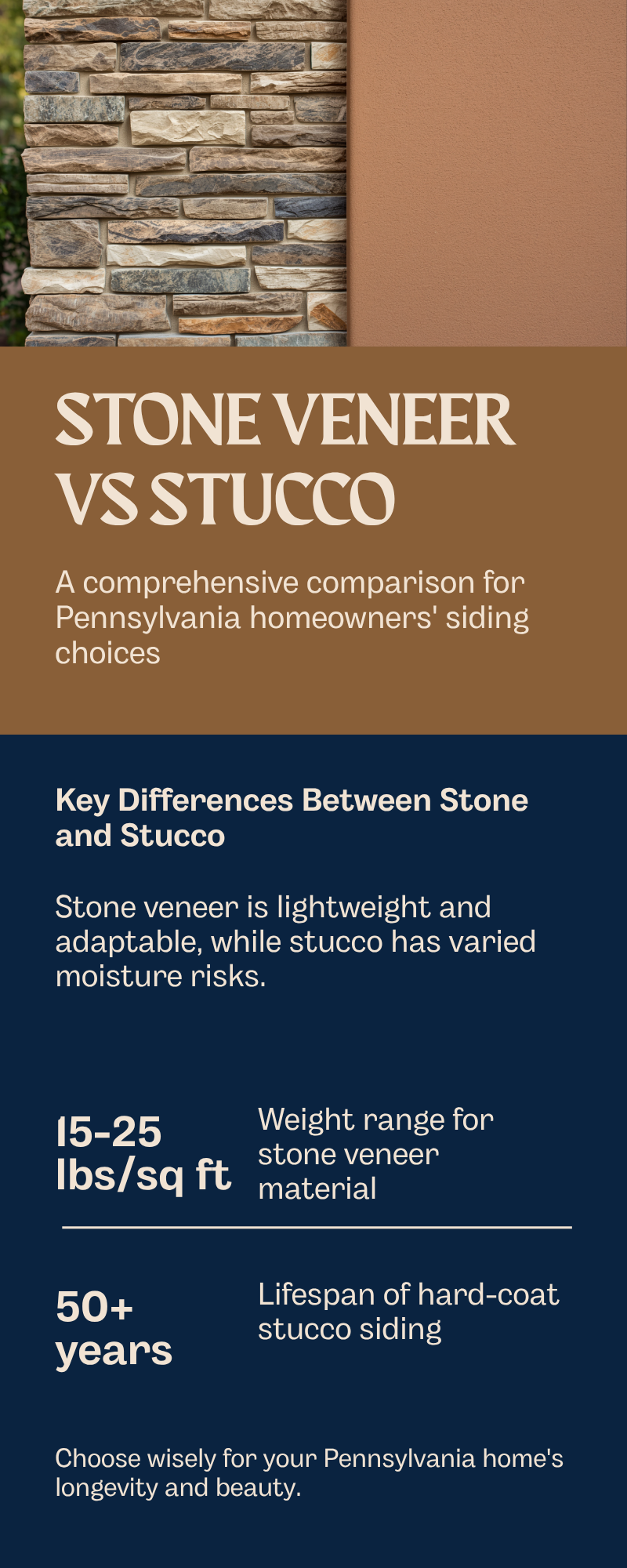
| Lifespan potential | 50+ years with proper maintenance | 15–25 years (if moisture-free) |
| PA real estate impact | Minimal — generally not flagged | Often requires inspection/remediation disclosure |
If you’re buying a Newtown or Lower Makefield home with stucco siding and it was built between 1985 and 2005, budget for a professional stucco inspection before closing. The cost of the inspection is trivial compared to a six-figure remediation.
Stone Veneer for Pennsylvania Homes: Manufactured vs. Natural
Stone veneer has none of the liability history of EIFS and has become one of the most popular accent siding materials in Bucks County over the past decade. Two main categories:
Manufactured (Adhered) Stone Veneer
- Weight: 15–25 lbs per sq ft [ESTIMATED — verify with contractor] — significantly lighter than natural stone. Does not require footings or special structural support in most residential applications.
- Installation: Applied with mortar over a metal lath and scratch coat on top of a weather-resistant barrier. Proper WRB installation and flashing at all penetrations, windows, and grade transitions is critical.
- Cost: $20–$45/sq ft installed [ESTIMATED — verify with contractor], varying by profile complexity and labor market.
- Moisture note: Manufactured stone veneer has its own moisture risk if improperly installed — the same drainage plane principles that protect hard-coat stucco apply here. ASTM C1780 standards govern installation.
Natural Stone Veneer
- Weight: 50–100+ lbs per sq ft [ESTIMATED — verify with contractor] — requires structural footing and engineering review for most applications.
- Cost: $35–$90/sq ft installed [ESTIMATED — verify with contractor] depending on stone type, availability, and complexity.
- Longevity: Effectively indefinite with proper mortar joint maintenance. Many historic PA homes have original stone exteriors standing 150+ years.
- PA sourcing advantage: Pennsylvania is a major source of fieldstone, bluestone, and other regionally appropriate materials — a genuine aesthetic and environmental advantage for natural stone installations.
What Actually Holds Up in the Pennsylvania Climate: A Practical Comparison
Bucks County sits in USDA climate zone 6b and experiences:
- Average annual precipitation: ~46 inches [Source: NOAA climate normals]
- Significant freeze-thaw cycling (typically 60–80 freeze-thaw events per winter season)
- Hot, humid summers with sustained 85–95°F periods
This climate is demanding on exterior cladding systems. Here’s how each material performs:
- Hard-coat stucco: Performs well when the drainage plane is correct. Vulnerable to cracking at corners, window surrounds, and penetrations if the substrate moves — common on wood-framed PA homes. Annual crack inspection and sealant maintenance required.
- EIFS (modern drainage systems): Contemporary EIFS products with integrated drainage channels perform better than original barrier systems — but the category still carries stigma in PA real estate and home inspection contexts.
- Manufactured stone veneer: Excellent durability in PA freeze-thaw conditions when properly installed over a drainage-capable WRB. Flash all horizontal ledges and grade contacts. Avoid low-grade mortar mixes that will crack and allow water infiltration.
- Natural stone: Best long-term performer in the PA climate, but heaviest and most expensive. Mortar joints require periodic repointing (every 20–40 years depending on exposure).
Why Flashing and Weather-Resistant Barriers Are Non-Negotiable for Both Materials
Regardless of whether you choose stone veneer or stucco for your Bucks County home, the single greatest predictor of long-term performance is the quality of the underlying system:
- Weather-resistant barrier (WRB): A continuous layer of housewrap, building paper, or liquid-applied membrane behind the cladding. This is the last line of defense when (not if) water gets past the cladding surface. Modern drainage-mat WRBs that create a 3/8″ air gap are the current best practice.
- Flashing at all penetrations: Windows, doors, hose bibs, electrical outlets, and any other penetration must have properly integrated, lapped flashing that directs water out and away from the building envelope. This is where most field failures originate.
- Grade and base-of-wall detailing: Stone veneer and stucco both fail at the base when they contact grade or get splash-back from hard surfaces. A minimum 4–6″ clearance from grade is required by code and good practice.
YBR GROUP’s siding installations in Warminster, Southampton, and Holland always include full WRB review and flashing replacement at windows and penetrations, not just the new cladding material. A new stone face over a compromised WRB is money thrown away.
YBR GROUP: Bucks County Siding Expertise Since 2016
YBR GROUP Inc has been serving Bucks County PA homeowners since 2016, working in Warminster, Levittown, Doylestown, Newtown, Southampton, Holland, and Lower Makefield. Our crews have remediated EIFS failures, installed manufactured and natural stone veneer, and applied traditional hard-coat stucco — we know the difference between a proper installation and one that will fail in 5 years. When you’re comparing stone veneer vs stucco Pennsylvania options, you need a contractor who understands the local housing stock and the specific failure modes each material has shown in PA conditions.
Frequently Asked Questions: Stone Veneer vs Stucco Pennsylvania
How do I know if my Pennsylvania home has EIFS or hard-coat stucco?
The simplest test: press on the surface firmly with your thumb. Hard-coat stucco feels like pressing on solid concrete — it won’t flex. EIFS has a foam backing and will give slightly under pressure. A professional stucco inspector can confirm with probe testing and non-destructive moisture scanning. If your home was built between 1985 and 2005, assume EIFS until proven otherwise.
Does stone veneer have moisture problems like EIFS?
Properly installed manufactured stone veneer with a drainage-capable weather-resistant barrier and correct flashing performs well in the Pennsylvania climate. The failure mode for stone veneer is different from EIFS — it’s typically improper flashing at windows, ledgers, and grade transitions rather than a systemic product defect. ASTM C1780 and manufacturer installation guidelines must be followed precisely.
Will EIFS affect my home’s resale value in Bucks County?
Yes, EIFS presence routinely triggers mandatory stucco inspection requirements in PA real estate transactions. If moisture damage is found, remediation costs can run $20,000–$80,000+ [ESTIMATED — verify with contractor] depending on extent of framing damage. Many Bucks County buyers request price reductions or stucco remediation as a condition of sale. Proactively addressing known EIFS issues before listing is generally advisable.
What is the best siding replacement for a Bucks County home with EIFS?
After EIFS removal and moisture remediation, the most popular replacement materials in Bucks County are James Hardie fiber cement (durable, low-maintenance, fire-resistant), vinyl siding, and manufactured stone veneer for accent areas. The right choice depends on your home’s style, budget, and neighborhood context. YBR GROUP can walk you through all options — call (267) 902-2393.
Stone Veneer or Stucco? Get Expert Guidance for Your Pennsylvania Home
YBR GROUP Inc has served Bucks County PA homeowners in Warminster, Levittown, Doylestown, Newtown, Southampton, Holland, and Lower Makefield since 2016. We install stone veneer, hard-coat stucco, and James Hardie siding — and we’ve seen the full range of EIFS failures in the local housing stock. Get an honest assessment before you invest.
Call or text YBR GROUP: (267) 902-2393