TPO vs EPDM Flat Roofing Pennsylvania: A Direct Comparison for PA Building Owners
If your Pennsylvania property has a flat or low-slope roof, you’re facing a choice between two dominant single-ply membrane systems: TPO (Thermoplastic Polyolefin) and EPDM (Ethylene Propylene Diene Monomer). Both are proven, code-compliant systems used on commercial and residential flat roofs throughout Bucks County and Pennsylvania — but they perform differently in the PA climate and have distinct trade-offs in cost, installer skill requirements, and long-term maintenance profiles.
YBR GROUP Inc has been installing and replacing flat roofing systems throughout Bucks County PA since 2016. This guide gives you an honest, technical comparison so you can make an informed decision for your specific building.
TPO Roofing: What It Is and How It Performs in Pennsylvania
TPO (Thermoplastic Polyolefin) is a single-ply roofing membrane that has grown from a niche product to the dominant flat roofing material in the U.S. over the past two decades. Key characteristics:
- Color and reflectivity: Standard TPO is white or light gray, with a solar reflectance index (SRI) that typically qualifies for ENERGY STAR cool roof designation [Source: EPA ENERGY STAR]. In Pennsylvania’s climate zone 4A, where air conditioning costs are meaningful from May through September, this reflectivity reduces cooling loads on HVAC-heavy commercial buildings.
- Seam construction: TPO seams are heat-welded using a hot-air welder. A properly executed heat weld fuses the two layers into a monolithic bond stronger than the membrane itself — this is TPO’s primary structural advantage over EPDM’s adhesive seams.
- Lifespan: 15–25 years depending on membrane thickness (60 mil vs 80 mil), UV exposure, and ponding water management [ESTIMATED — verify with contractor and manufacturer warranty].
- PA climate performance: TPO handles UV exposure well. Early-generation TPO (pre-2010) had oxidation and seam failure issues, but membrane chemistry has improved substantially. Modern 60-mil and 80-mil TPO from established manufacturers performs reliably in PA freeze-thaw conditions.
- Cost: $5–$10 per sq ft installed for standard commercial applications [ESTIMATED — verify with contractor]. Thicker membranes and more complex roofs cost more.
EPDM Roofing: The Proven Rubber Membrane for Pennsylvania Flat Roofs
EPDM (Ethylene Propylene Diene Monomer) is a synthetic rubber membrane with a 50+ year track record in commercial and residential flat roofing. It predates TPO by decades and remains a standard choice for Pennsylvania buildings:
- Color: Standard EPDM is black (a white version exists but is less common). The black color absorbs heat — in PA summers, this means EPDM roofs run significantly hotter than TPO, which can increase cooling loads on the building and accelerate thermal degradation of the membrane and adhesives over decades.
- Seam construction: Traditional EPDM uses contact cement (adhesive) at seams, or self-adhering tape systems. Adhesive seams are inherently more vulnerable to failure than heat-welded TPO seams — they can delaminate with age, UV exposure, and thermal cycling. Mechanically fastened EPDM avoids seam adhesive but introduces penetrations into the membrane field.
- Lifespan: 20–30 years with proper installation and maintenance [ESTIMATED — verify with contractor and manufacturer warranty]. EPDM’s proven track record on this front is one of its strongest selling points.
- PA climate performance: EPDM’s rubber composition handles freeze-thaw cycling excellently — rubber remains flexible well below freezing, unlike some early TPO formulations. For PA buildings with significant winter exposure (north-facing roofs, unheated storage buildings in Doylestown or Newtown), EPDM’s cold-weather flexibility is a genuine advantage.
- Cost: $4–$9 per sq ft installed [ESTIMATED — verify with contractor]. Generally slightly lower than comparable TPO, though the gap has narrowed as TPO has become the higher-volume product.
TPO vs EPDM Head-to-Head: What Matters for Pennsylvania Buildings
| Factor | TPO | EPDM |
|---|---|---|
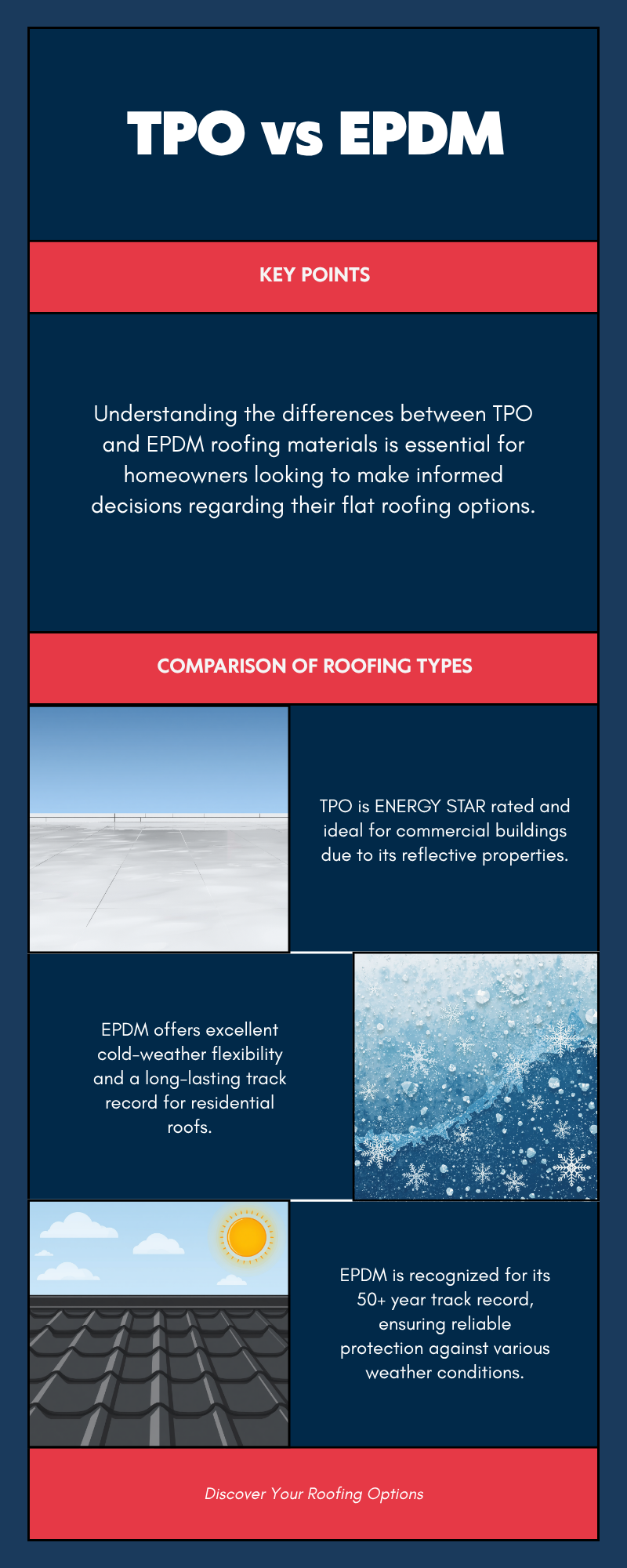
| Seam strength | Stronger — heat-welded monolithic bond | Weaker — adhesive or tape (can delaminate) |
| Energy efficiency | Better — white/reflective, ENERGY STAR rated | Black surface absorbs heat; white EPDM available at premium |
| Cold weather flexibility | Good on modern formulations | Excellent — rubber stays flexible below freezing |
| Proven track record | ~20 years (modern formulations) | 50+ years of documented performance |
| Installer skill dependency | High — heat welding requires trained operator | Moderate — adhesive seams more forgiving |
| Repairability | Good — patch-welded with hot air | Easy — contact cement patches are field-simple |
| Cost (installed) | $5–$10/sq ft [ESTIMATED] | $4–$9/sq ft [ESTIMATED] |
Which System Handles the Pennsylvania Climate Better?
Pennsylvania’s climate zone 4A (per IECC) presents a demanding combination for flat roofing:
- Summer heat: Consistent 85–95°F ambient temperatures with flat roofs reaching 140–160°F surface temperatures [Source: Oak Ridge National Laboratory roofing research]. TPO’s reflective white surface significantly reduces this thermal load compared to black EPDM. For a commercial building in Warminster or Southampton with significant cooling costs, this difference is measurable on the utility bill.
- Freeze-thaw cycling: PA typically sees 60–80 freeze-thaw cycles per winter season [Source: NOAA climate data]. Both TPO and EPDM handle freeze-thaw well in modern formulations. EPDM’s rubber chemistry gives it a slight edge at extreme cold flexibility, relevant for unheated structures.
- UV exposure: PA receives moderate UV loading (not as intense as the Southwest). Both materials handle PA UV levels adequately when membrane thickness is appropriate — 60 mil minimum, 80 mil preferred for longer service life expectations.
- Ponding water: Both systems are vulnerable to chronic ponding water, which degrades adhesives (EPDM), membrane chemistry, and fastener pullout. Proper slope-to-drain design (minimum 1/4″ per foot, per IBC) is more important than material choice for ponding prevention.
For a typical Bucks County commercial building or residential flat-roof addition with HVAC equipment on the roof, TPO’s energy efficiency advantage is meaningful. For unheated structures, detached garages, or buildings where a contractor crew with strong EPDM experience is available, EPDM remains a solid, cost-effective choice.
Why Installer Skill Matters More Than Material Choice for Flat Roofing
The single most important variable in flat roofing performance — more important than TPO vs EPDM — is installer quality. This is especially true for TPO.
Heat welding TPO seams requires a calibrated hot-air welder, correct temperature settings for the ambient conditions, proper overlap width, and an experienced operator who can read weld quality by feel and appearance. An under-welded TPO seam looks fine from above and fails within 3–5 years. An over-welded seam burns the membrane and creates an immediate weak point.
EPDM adhesive seams are more forgiving — the contact cement application process is learnable faster — but improper seam preparation (contaminated surfaces, inadequate bond width, inappropriate ambient temperatures during installation) still produces early failures.
When evaluating flat roofing contractors in Bucks County PA, ask directly: how many flat roofs of this type and size has the crew installed in the past 12 months? Request references for commercial flat roof work specifically. YBR GROUP installs both TPO and EPDM systems and can provide references for both material types from recent projects in the Doylestown and Newtown area.
Flat Roofing for Residential vs. Commercial Pennsylvania Buildings
Both TPO and EPDM are used on residential flat roofs (row homes, additions, porch roofs, garage roofs) and commercial buildings in Bucks County. A few distinctions:
- Residential flat roofs are typically smaller, may have more penetrations (skylights, HVAC vents, plumbing stacks) relative to total area, and are often connected to pitched roof sections requiring careful flashing at the transition. EPDM’s easy field-patching makes it a practical choice for smaller residential jobs. TPO’s energy efficiency benefit is proportionally smaller on a 400 sq ft porch roof than on a 10,000 sq ft commercial flat.
- Commercial flat roofs are where TPO’s ENERGY STAR qualification becomes economically significant. Many commercial roofing projects in Pennsylvania require ENERGY STAR compliance for tax incentive eligibility or utility rebate programs. TPO white membranes typically qualify; black EPDM typically does not without an added reflective coating.
- Warranty coverage: Both TPO and EPDM carry manufacturer warranties (typically 15–30 years depending on membrane thickness and brand), but commercial warranty programs often require manufacturer-authorized installer certification. Confirm your contractor’s certification status with the specific membrane manufacturer before contract execution.
YBR GROUP: Flat Roofing Expertise in Bucks County PA Since 2016
YBR GROUP Inc has been installing TPO and EPDM flat roofing systems on commercial and residential buildings throughout Bucks County PA since 2016. Our flat roofing work spans Warminster, Levittown, Doylestown, Newtown, Southampton, Holland, and Lower Makefield — including commercial buildings, residential additions, and mixed-use structures with combined flat and pitched roof sections. We’ll recommend the right system for your specific building, use case, and budget — not the one with the higher margin for us.
Frequently Asked Questions: TPO vs EPDM Flat Roofing Pennsylvania
How long do TPO and EPDM roofs last in Pennsylvania?
With proper installation and routine maintenance, TPO typically lasts 15–25 years and EPDM 20–30 years in Pennsylvania conditions [ESTIMATED — verify with contractor and manufacturer warranty documentation]. Membrane thickness matters: 80-mil membranes outperform 45-mil membranes significantly. Both systems benefit from annual inspection, seam checks, and prompt repair of any punctures or flashing failures.
Can TPO or EPDM be installed in winter in Bucks County PA?
Cold-weather installation is possible but requires precautions. EPDM adhesives have minimum application temperature requirements (typically 40°F+) and bonding is compromised in extreme cold. TPO heat welding is less temperature-dependent but requires surface preparation (cleaning, drying) that is harder to achieve in winter precipitation. Emergency repairs can be done year-round; full roof replacements are generally planned for spring through fall in the Bucks County market.
Is TPO or EPDM better for a residential flat roof addition in Bucks County?
For a typical residential flat roof addition — porch roof, sunroom, rear addition — both systems work well. EPDM is often the more cost-effective choice for smaller residential jobs where the energy efficiency premium of TPO doesn’t generate enough savings to justify the cost difference. However, if the addition is adjacent to a living space with HVAC below, TPO’s reflectivity can reduce cooling loads meaningfully. Call YBR GROUP at (267) 902-2393 for a site-specific recommendation.
What causes flat roof failures in Pennsylvania?
The most common flat roof failure causes in Pennsylvania are: (1) seam failures — either heat-weld defects in TPO or adhesive delamination in EPDM; (2) flashing failures at penetrations (HVAC curbs, pipes, skylights, parapet walls); (3) ponding water — chronic standing water degrades membranes and adhesives; (4) physical damage from foot traffic or debris. Proper slope-to-drain design and annual inspection catch most issues before they become interior water events.
Get a Flat Roof Assessment in Bucks County PA — TPO or EPDM
YBR GROUP Inc installs both TPO and EPDM flat roofing systems on commercial and residential buildings throughout Bucks County PA. We serve Warminster, Levittown, Doylestown, Newtown, Southampton, Holland, and Lower Makefield. Get an honest recommendation for your specific building — not a one-size-fits-all answer.
Call or text YBR GROUP: (267) 902-2393