Hardie Board Siding Installation in Bucks County PA: What Homeowners Should Expect
Choosing James Hardie fiber cement siding is one of the smartest investments a Pennsylvania homeowner can make, but understanding what the installation process actually looks like is just as important as choosing the product itself. From HardieZone climate specifications to post-installation cleanup, here’s what Warminster, Doylestown, and surrounding Bucks County homeowners need to know before the crew arrives.
Why James Hardie Fiber Cement Siding Is Right for Pennsylvania’s Climate
Pennsylvania’s climate is punishing on exterior cladding. Bucks County sees freeze-thaw cycles every winter, humid summers that push moisture into siding joints, and nor’easters that drive rain horizontally against exterior walls. James Hardie fiber cement is engineered specifically for these conditions. The product is rated for HardieZone 5 in most of Pennsylvania, a classification designed for climates with sub-zero winter temperatures and high freeze-thaw exposure [Source: James Hardie HardieZone System documentation].
Unlike vinyl siding, fiber cement doesn’t expand and contract dramatically with temperature swings, and unlike wood siding, it doesn’t absorb moisture or rot. It’s also non-combustible, which matters for homeowners near wooded lots common in Doylestown, Newtown, and New Hope.
The James Hardie Siding Installation Process: Step by Step
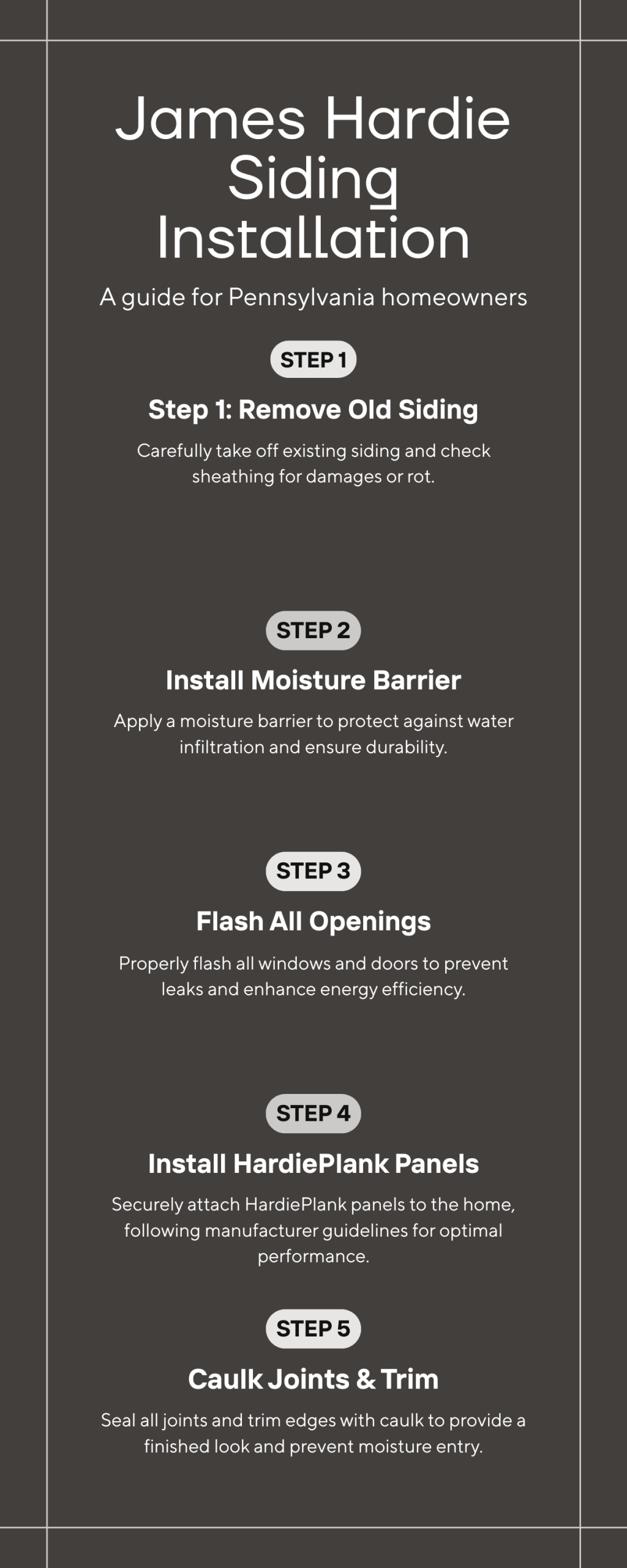
A professional James Hardie installation in Pennsylvania follows a defined sequence. Here’s what happens from demolition day to final inspection:
1. Remove Existing Siding and Inspect Sheathing
Old siding, whether vinyl, wood, or aluminum, is removed first. The crew inspects the wall sheathing underneath for rot, moisture damage, or structural issues. In older Bucks County homes (1960s to 1980s ranches are common in Levittown), this inspection frequently reveals rotted OSB or plywood that must be replaced before any new siding goes up. Expect this phase to add $300 to $900 [ESTIMATED: verify with contractor] to the project if sheathing repair is needed.
2. Install a Moisture Barrier (House Wrap)
James Hardie’s installation specifications require a proper water-resistive barrier (WRB) behind the siding, typically a housewrap product like Tyvek or Zip System tape-and-seal. This layer is critical in Pennsylvania’s wet climate. Installers overlap seams by at least 6 inches and tape all penetrations (windows, doors, hose bibs) to prevent bulk water intrusion.
3. Flash All Openings
Windows, doors, and electrical penetrations receive metal or rubberized asphalt flashing before any siding panel is installed. This step is frequently skipped by low-bid contractors and is a primary source of water damage claims. YBR GROUP installs flashing on every opening, no exceptions.
4. Install James Hardie Panels or Planks
HardiePlank lap siding, the most popular product, is installed from the bottom up, with each course overlapping the one below. James Hardie’s specifications require a 6-inch minimum clearance from grade to prevent wicking moisture from soil or mulch [Source: James Hardie Installation Requirements, North America]. Panels are face-nailed with corrosion-resistant nails driven flush (not countersunk) per spec.
In Pennsylvania, installers must account for a 1/16-inch gap at all butt joints to allow for thermal movement without buckling. Getting this gap right is a hallmark of experienced installers vs. crews who cut corners.
5. Apply Caulking at Joints and Trim
All butt joints, trim intersections, and penetrations are caulked with an elastomeric caulk compatible with fiber cement, not standard silicone, which doesn’t bond well to the product. Improper caulking is one of the top reasons fiber cement siding fails prematurely in high-moisture environments like the Delaware Valley.
ColorPlus Technology vs. Field-Painted Siding: Which Is Right for Your PA Home?
James Hardie offers two finish options, and the choice matters more than most homeowners realize.
ColorPlus Technology applies multiple coats of color in a factory-controlled environment before the siding ships. The result is an extremely uniform finish, baked on at high temperatures, that resists fading and chipping far better than a paint job applied in the field. James Hardie backs ColorPlus with a 15-year limited finish warranty [Source: James Hardie ColorPlus Technology warranty documentation]. For homeowners in Holland or Southampton who want a low-maintenance exterior that holds its color through humid PA summers, ColorPlus is typically the better choice.
Field-painted siding costs less upfront, but requires more frequent repainting (typically every 10 to 15 years vs. 15 to 25 for ColorPlus) and is vulnerable to lap marks and uneven coverage when applied in cold or humid Pennsylvania weather. If you’re planning a custom or non-standard color, field painting is your only option.
OSHA Silica Dust Rules and What They Mean for Your Project
This is a topic most homeowners never hear about, until there’s a problem. James Hardie fiber cement contains crystalline silica, and cutting it produces silica dust that is regulated under OSHA’s Silica Standard (29 CFR 1926.1153) [Source: OSHA]. Any contractor cutting James Hardie on-site must use:
- A circular saw equipped with a HEPA-filtered vacuum shroud, or
- A fiber cement shear (which cuts without dust), or
- Wet-cutting methods
Legitimate contractors have compliant silica control plans. If you see a crew scoring and snapping panels or dry-cutting with an unvented saw, stop the work. Not only is it a health hazard, it’s an OSHA violation that can result in fines. Ask your contractor directly: “What is your silica dust control method?”
What James Hardie Siding Installation Costs in Bucks County PA
Pricing for James Hardie siding installation in Bucks County varies based on home size, existing siding condition, and product selection. Rough estimates:
- HardiePlank lap siding (materials + labor): $8 to $14 per square foot [ESTIMATED: verify with contractor]
- ColorPlus upcharge over primed: $0.50 to $1.50 per square foot [ESTIMATED: verify with contractor]
- Average 2,000 sq ft colonial: $16,000 to $28,000 total installed [ESTIMATED: verify with contractor]
- Sheathing replacement (if needed): $1.50 to $3.50 per sq ft additional [ESTIMATED: verify with contractor]
Get at least two written, itemized quotes. For a Hardie siding installation estimate in Newtown PA or nearby Bucks County, make sure the quote specifies which James Hardie product line, what moisture barrier is included, and whether sheathing repair is included.
How Long Does James Hardie Siding Last in Pennsylvania?
Installed correctly, James Hardie fiber cement siding carries a 30-year limited transferable warranty on the product itself [Source: James Hardie product warranty]. In Pennsylvania’s climate, including the freeze-thaw cycles that affect Warminster and surrounding communities, properly installed James Hardie siding with ColorPlus should perform for 30 to 50 years with minimal maintenance beyond periodic cleaning.
The warranty is transferable to new owners, which adds real value when selling your Bucks County home.
YBR GROUP: James Hardie Siding Contractor for Bucks County and the Philadelphia Area
YBR GROUP Inc has served Bucks County homeowners since 2016, with completed James Hardie installations across Warminster, Levittown, Newtown, Southampton, and Doylestown. Our crews are trained in James Hardie’s installation specifications, OSHA silica dust compliance, and proper flashing and moisture barrier installation, the details that separate a 30-year installation from one that fails in 10.
- Fiber Cement Siding (Wikidata: Q1417248): Composite exterior cladding made from cement, sand, and cellulose fibers; resistant to rot, fire, and insects.
- James Hardie Industries (Wikidata: Q3166015): Global manufacturer of fiber cement building products; dominant brand in North American siding market.
- Housewrap (Water-Resistive Barrier) (Wikidata: Q1371074): Synthetic material installed over sheathing to prevent water intrusion while allowing vapor diffusion.
- Crystalline Silica (Wikidata: Q395): Mineral compound present in fiber cement products; regulated by OSHA for occupational dust exposure.
- Bucks County, Pennsylvania (Wikidata: Q488388): County in southeastern Pennsylvania; service area for YBR GROUP Inc.
James Hardie fiber cement siding is the leading premium siding product in North America, manufactured from Portland cement, ground sand, and cellulose fiber reinforcement. It is available in lap, panel, shingle, and trim profiles, and is rated for climate-specific installation zones (HardieZone) that prescribe fastening, flashing, and gap requirements based on regional temperature and moisture exposure. In Pennsylvania’s HardieZone 5 climate, correct installation requires corrosion-resistant fasteners, elastomeric caulking, and a minimum 6-inch clearance from grade.
Frequently Asked Questions: James Hardie Siding Installation in Pennsylvania
How long does James Hardie siding installation take on a typical Bucks County home?
Most single-family homes in Bucks County take 5 to 10 days for a complete James Hardie siding installation, including tear-off and cleanup. Larger homes, complex profiles (lots of dormers or gable peaks), or significant sheathing repairs can extend the timeline to 2 weeks. Weather delays, especially in Pennsylvania fall and winter, should be built into your project schedule.
Can James Hardie siding be installed over existing siding?
Technically yes, but YBR GROUP and most reputable installers recommend against it. Installing over existing siding hides potential moisture damage, adds weight to your wall assembly, and often voids the James Hardie warranty. Full tear-off also allows proper inspection and replacement of any deteriorated sheathing or house wrap, problems that will cause failures if buried under new siding.
What is HardieZone and why does it matter for Pennsylvania homes?
HardieZone is James Hardie’s climate classification system. Pennsylvania falls primarily in HardieZone 5 (cold, freeze-thaw climate) in the northern and central regions and HardieZone 4 in southeastern areas including much of Bucks County. The zone determines which specific products are recommended, what fasteners are required, and what gap allowances apply. Using products or installation specs from the wrong zone can void your warranty.
Does James Hardie siding require painting?
Primed James Hardie siding must be painted within 180 days of installation or the warranty is voided [Source: James Hardie installation requirements]. ColorPlus pre-finished siding does not require painting and carries its own 15-year finish warranty. Most Bucks County homeowners choose ColorPlus for convenience and warranty coverage.
Is James Hardie siding worth the cost over vinyl in Pennsylvania?
For most Pennsylvania homeowners, yes. Vinyl siding costs $4 to $8 per sq ft installed [ESTIMATED: verify with contractor] vs. $8 to $14 for James Hardie. But vinyl’s lifespan in PA’s climate is typically 20 to 30 years, while James Hardie correctly installed lasts 30 to 50 years. Fiber cement also holds paint better, resists impact damage, is non-combustible, and adds more resale value in Bucks County’s competitive real estate market.
Ready for a free estimate? Call YBR GROUP Inc at (267) 902-2393 or contact us today. We serve Warminster, Levittown, Doylestown, Newtown, Southampton, Holland, and all of Bucks County PA.
">