When Bucks County homeowners decide it’s time to replace their siding, two options come up in almost every conversation: James Hardie fiber cement and vinyl siding. Both are widely installed across Pennsylvania. Both have genuine advantages. Neither is the right answer for every home.
This is not a post designed to sell you one product. It’s a breakdown of how each material actually performs in Pennsylvania’s climate, what each costs relative to the other, and how to think through the decision for your specific situation.
What Is James Hardie Fiber Cement Siding?
James Hardie fiber cement siding is manufactured from a composite of cement, sand, and cellulose fiber. The result is a rigid panel that looks like wood lap siding but performs unlike wood in virtually every measurable category.
James Hardie produces its products under the HardiePlank and HardiePanel product lines. Many homeowners choose panels with ColorPlus Technology — a factory-applied, multi-coat finish baked directly onto the panel. ColorPlus Technology is designed to resist fading, chipping, and cracking better than field-applied paint.
Fiber cement is non-combustible. It does not rot, and it is not a food source for termites or carpenter ants. James Hardie backs its fiber cement siding with a 30-year limited warranty.
What Is Vinyl Siding?
Vinyl siding is manufactured from PVC (polyvinyl chloride). It is the most widely installed siding material in the United States due to its low upfront cost and minimal maintenance requirements.
Vinyl does not need painting. It does not rot. It resists moisture well, and it is available in a broad range of colors and profiles. Installation is faster than fiber cement, which contributes to lower labor costs. For homeowners with a tighter budget or a shorter time horizon on the home, vinyl is a rational choice.
The trade-off is material density and long-term durability. Vinyl is lighter and less rigid than fiber cement. It can warp or crack under certain temperature extremes, and its surface cannot be repainted if the color fades.
How Pennsylvania’s Climate Affects Siding Performance
Pennsylvania’s climate is one of the more demanding in the mid-Atlantic region for exterior materials. Bucks County specifically sees:
Freeze-thaw cycles. Temperatures swing repeatedly through the freezing point from December through March. Materials that absorb moisture are vulnerable to expansion and contraction damage. Fiber cement handles freeze-thaw better than standard vinyl due to its density and rigidity.
Summer humidity and heat. Southeastern Pennsylvania summers bring high humidity and sustained heat. Vinyl siding can warp or buckle when surface temperatures spike on south- and west-facing walls. Fiber cement does not have this vulnerability.
Hail and impact. Bucks County sees occasional hail during spring and summer storm systems. Fiber cement is significantly more impact-resistant than vinyl. Vinyl can crack or dent from hail or physical impact; fiber cement generally resists surface damage at comparable impact levels.
UV exposure. Both materials are affected by prolonged UV exposure. Vinyl fades over time and cannot be refinished. James Hardie ColorPlus Technology panels are engineered for UV resistance, and if fading occurs over the long term, fiber cement panels can be repainted — vinyl cannot.
For Pennsylvania homeowners planning to stay in their homes for 15 or more years, fiber cement’s resilience against these climate factors is a meaningful advantage.
Cost Comparison — James Hardie vs. Vinyl in Bucks County
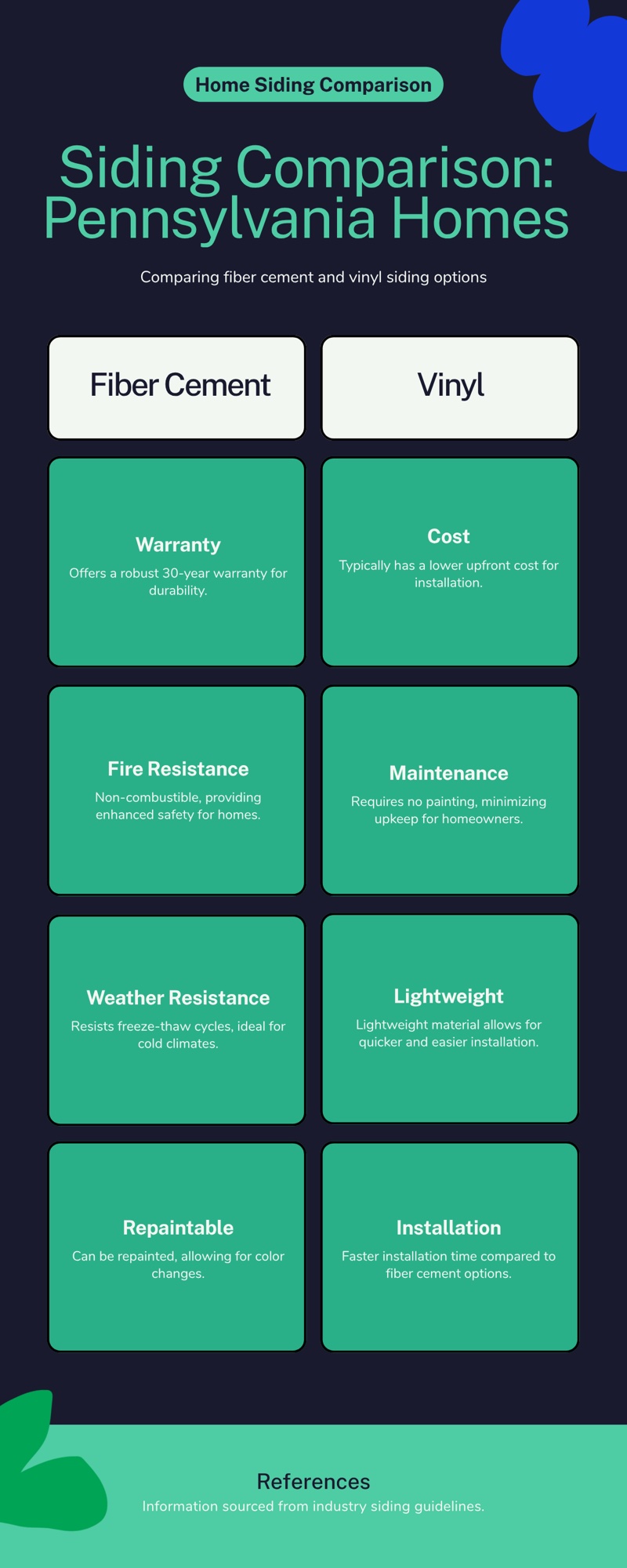
James Hardie fiber cement siding costs more than vinyl siding. That gap is real, and it reflects both material cost and the additional labor required for proper fiber cement installation.
Vinyl is a lighter material and installs faster, which reduces labor time and total project cost. It is the more budget-accessible option for homeowners who need to replace siding without a premium investment.
Fiber cement’s higher upfront cost is partially offset by its longer service life and lower long-term maintenance needs. Because it can be repainted, ColorPlus fading does not require panel replacement.
In our Bucks County projects, fiber cement installation consistently runs higher than comparable vinyl — the premium reflects both material cost and the additional care required for proper fiber cement installation at joints, trim, and penetrations. Specific costs vary by project scope, home size, material selection, and current labor and material market conditions. YBR GROUP provides free estimates for Bucks County siding projects — contact us directly for accurate pricing on your specific home rather than relying on general ranges that may not reflect current conditions.
Which Siding Lasts Longer in Pennsylvania?
James Hardie fiber cement siding carries a 30-year limited warranty. In real-world performance in Pennsylvania’s climate, properly installed and maintained fiber cement routinely meets or exceeds that lifespan.
Vinyl siding manufacturers’ warranty periods vary by product line and manufacturer. Standard vinyl siding typically has a shorter expected service life than fiber cement, and performance under Pennsylvania’s freeze-thaw cycles and summer heat can reduce actual longevity below rated estimates.
If long-term durability is the primary decision criterion, fiber cement has a clear advantage.
Which Is Right for Your Bucks County Home?
There is no single correct answer. Here is a practical decision framework:
Choose James Hardie fiber cement if:
- You plan to stay in the home for 15 or more years
- Your neighborhood has an HOA with requirements for premium materials
- Your home is a historic or older property where wood-look aesthetics matter
- You want a material that can be repainted if your color preferences change
- Long-term durability and warranty coverage are higher priorities than upfront cost
Choose vinyl siding if:
- Budget is the primary constraint and the cost difference is significant for your situation
- You have a shorter time horizon on the home (under 10 years)
- You want the lowest-maintenance exterior possible with no future painting required
- The home is a rental property or investment property where longevity vs. cost is weighed differently
Both materials, when installed correctly by an experienced contractor, will protect your home and improve its appearance. Installation quality matters as much as material selection. Improperly installed fiber cement can allow moisture intrusion at joints and trim. Improperly installed vinyl can buckle or gap.
Get a Free Siding Estimate in Bucks County, PA
YBR GROUP Inc has installed James Hardie siding and vinyl siding on homes throughout Bucks County, PA since 2016. We work with both materials and will give you an honest assessment of which makes sense for your home, your budget, and your plans — not a sales pitch for one product over the other.
Call us at (267) 902-2393 or visit our siding services page to schedule a free estimate. We serve Bucks County and surrounding areas throughout PA, NJ, and DE. If your siding project follows storm damage that also affected your roof, see: 7 Signs Your Bucks County Roof Needs Replacement.