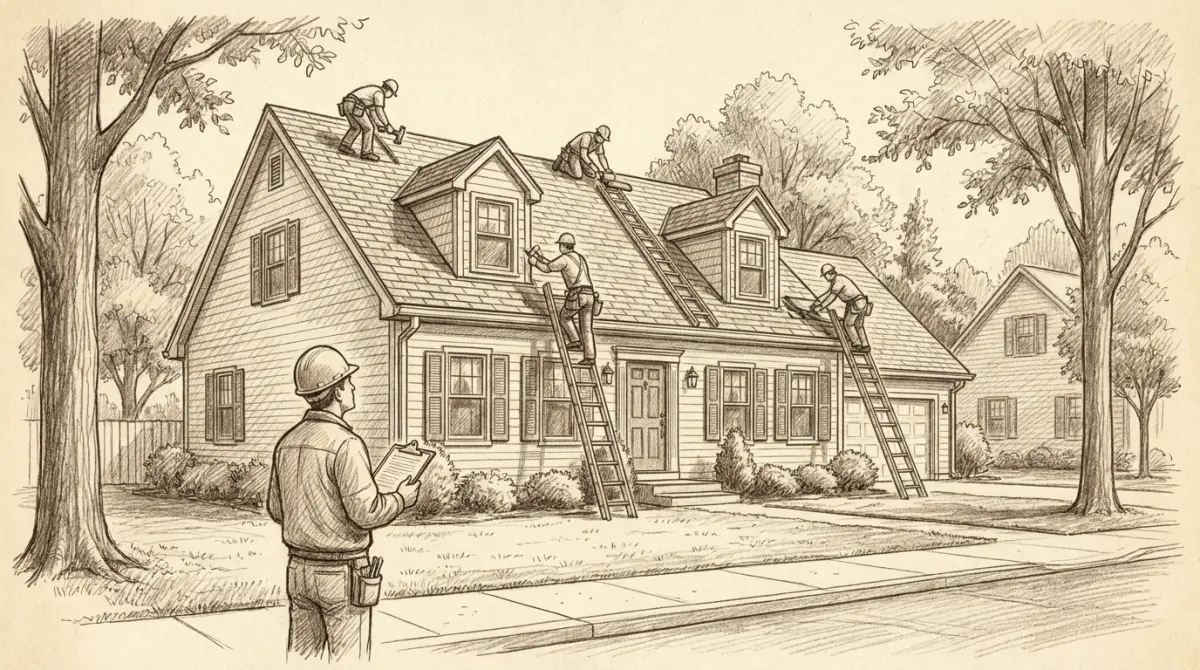
A permitted roof replacement brings a township inspector to the job, which is a second set of eyes on the work you are paying for.
If you are planning a roof replacement, one of the first questions that comes up is whether the job requires a building permit. It is a fair question, and the answer matters, because skipping a required permit can create problems with your township, your insurance company, and even a future home sale. In Bucks County, permit rules are set at the municipal level, not the county level, which means the answer depends on where your home sits. Below we walk through how permitting generally works for roofing projects in this area, what homeowners should ask before work begins, and how a contractor who pulls permits properly protects you from headaches down the road.
Why Roofing Permits Exist in the First Place
Building permits are not paperwork for paperwork’s sake. They exist so that a local building inspector can confirm the work meets the applicable building code, including proper decking condition, correct underlayment and flashing installation, and safe attachment of new roofing material. Pennsylvania has a statewide building code, the Uniform Construction Code, which the Department of Labor and Industry describes as a code that “has to be followed by builders in the state.” Enforcement, though, is local: more than 90 percent of Pennsylvania’s 2,562 municipalities have elected to administer and enforce the UCC themselves [PA Department of Labor and Industry, verified September 4, 2026]. That single fact explains most of the confusion around roofing permits. The code is statewide, but the office that decides what your project needs, and what it costs, is your township.
For a homeowner, the permit process is really a built-in inspection step. It gives you a second set of eyes, someone outside the contractor relationship, confirming the roof was installed the way it should be. That protects your investment and can matter later if you ever need to show a buyer or an insurance adjuster that the roof was done to code.
What Bucks County Townships Actually Say About Roof Permits
Bucks County does not run a single county-wide permit office. Each township and borough operates its own building and code enforcement department, so the answer genuinely depends on your address. On September 4, 2026 we went through the official websites of eight Bucks County municipalities to see what each one publishes about roof replacement. Here is what we found.
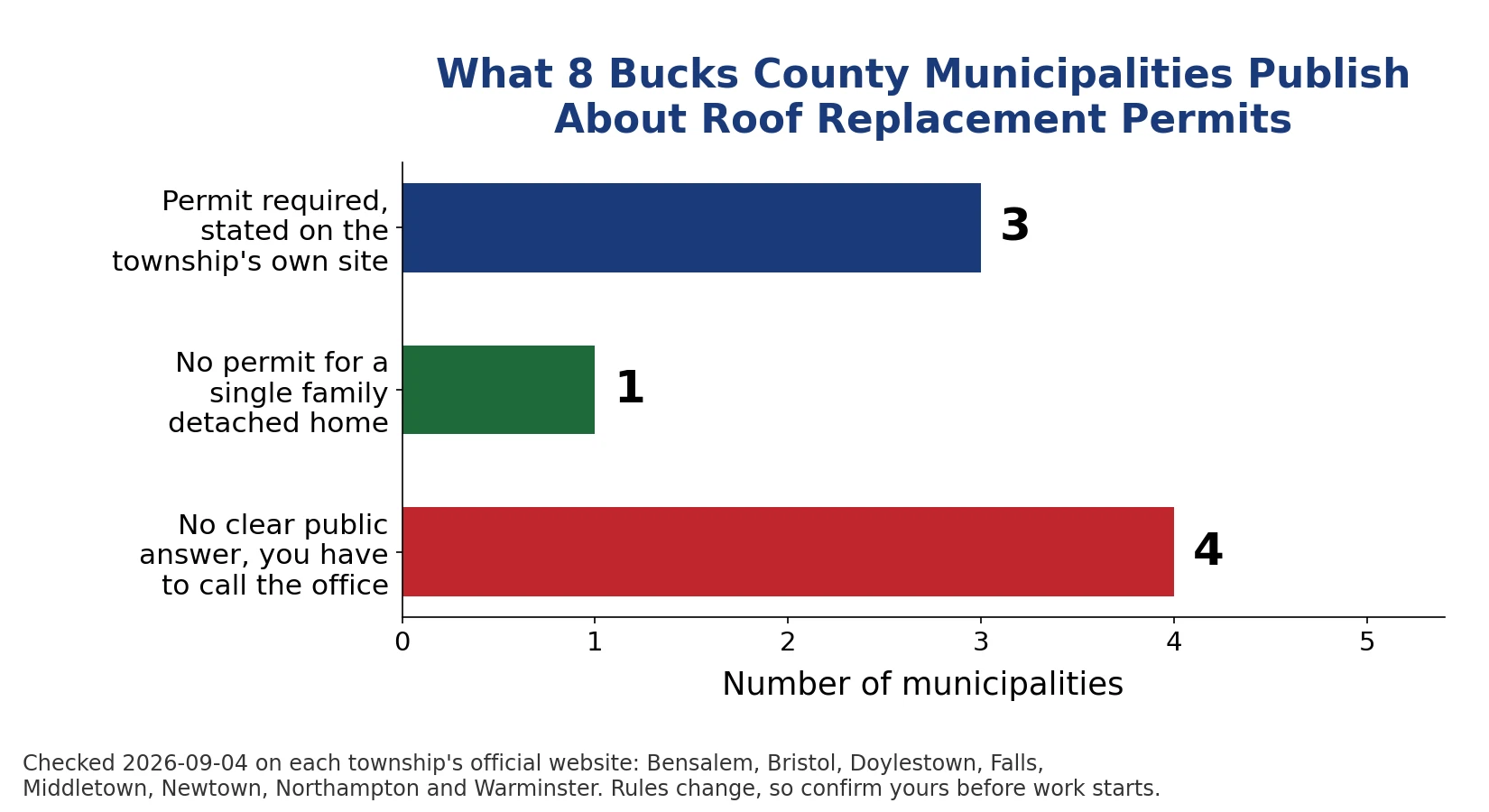
Half the townships we checked do not publish an answer at all, and one of them says outright that a detached house does not need a permit. That spread is the whole point: there is no single Bucks County rule to rely on.
One township says you do not need a permit at all
This is the finding most homeowners get wrong. Newtown Township states plainly in its own FAQ: “Any single family detached home does not need a permit for a roof replacement. Townhomes/attached single family dwellings do need to secure a permit for roof replacement” [newtownpa.gov, verified September 4, 2026]. So if you own a detached house in Newtown Township, the permit question is already answered, and a contractor telling you otherwise is either mistaken or padding the invoice. If you own a townhome there, the opposite applies.
Three townships publish a clear requirement
- Northampton Township has a dedicated Roof and Exterior Veneer Permit Application, last revised July 8, 2026. The form asks whether the job strips down to the decking and how many layers of shingle are already on the roof, which tells you a permit covers both a full tear-off and an overlay [northamptontownship.com, verified September 4, 2026].
- Middletown Township puts roofing under “Alterations, Repairs and Other Structures” in its 2026 fee schedule. The residential fee is 1.5 percent of the cost of the job, with a 150 dollar minimum [middletownbucks.org 2026 fee schedule, verified September 4, 2026].
- Doylestown Township names re-roofing directly in its 2026 fee schedule, though only in the non-residential alterations category, priced at 1.5 percent of construction cost with a 350 dollar minimum. Residential re-roofing is not called out on its own line and would fall under general residential alterations, which carries a 200 dollar minimum. Because the schedule does not name residential re-roofing explicitly, treat that as a number to confirm with the township rather than a quoted price [doylestownpa.org 2026 fee schedule revised April 14, 2026, verified September 4, 2026].
Four townships do not publish an answer at all
Bensalem, Bristol Township, Warminster Township and Falls Township all maintain building departments and fee schedules, but none of them states a plain yes or no for roof replacement, and none publishes an extractable roofing fee. We are not going to invent numbers for them. For those four, the real answer is a phone call to the building department before work starts, and any contractor quoting you a permit fee for those townships should be able to tell you exactly where the number came from.
The practical takeaway is that “do I need a permit” has no single Bucks County answer, and anyone who gives you one without asking your township has not checked. Rules also change: everything above reflects what these municipalities published on September 4, 2026.
Call (267) 902-2393 For a Free Estimate
What Happens If You Skip a Required Permit
Some homeowners assume that skipping the permit saves time or money, but this shortcut can backfire in several ways:
- Unpermitted work discovered later can require the roof to be opened up for inspection, adding cost and delay after the fact.
- Some townships issue fines for work completed without a required permit.
- Home insurance claims related to roof damage can be complicated or denied if the work was not permitted and inspected properly.
- Unpermitted roofing work can surface during a home inspection at resale, slowing down or jeopardizing a sale.
- A roof installed without inspection oversight has no independent confirmation that it meets code, which matters for both safety and long-term performance.
None of these outcomes are worth the small amount of time it takes to confirm whether a permit applies to your project.
Who Is Responsible for Pulling the Permit
In most cases, the roofing contractor pulls the permit on the homeowner’s behalf, since they are the one performing the work and are familiar with the process. This is standard practice and something you should confirm as part of your written estimate. When you are comparing quotes, ask directly whether the price includes permit fees and whether the contractor will handle filing with your township. A contractor who is willing to put this in writing and walk you through the process is showing you they operate transparently. If you are early in the planning stage and still weighing options, our roof replacement cost guide for Bucks County is a useful place to start, since permit fees are one of the line items that can factor into your total project cost.
How the Permit Process Fits Into Your Project Timeline
Permitting adds a step to the front end of your project. Depending on the township, approval can be fast or can take longer if the office is backed up or if additional documentation is requested. This is one reason it helps to plan a roof replacement rather than treat it as a same-week emergency whenever possible. If you are wondering how the permit step fits into the overall project schedule, from the initial inspection through tear-off, installation, and final walkthrough, our page on how long a roof replacement takes in Bucks County breaks down each phase, including where permitting and inspection typically fall in the sequence.
It also helps to know in advance whether your project might trigger additional review. For example, if your roof replacement includes changes to attic ventilation, some townships want that noted in the permit application. If you are not sure whether your current ventilation setup needs attention as part of the reroofing project, our guide on attic ventilation and your roof explains why proper venting is part of a code-compliant, long-lasting roof system.
Permits and Roof Inspections Go Hand in Hand
A permitted roofing job typically includes at least one inspection by the township’s code enforcement officer, sometimes at the decking stage and again at completion. This inspection is separate from, but related to, the kind of pre-project inspection a roofing contractor performs to evaluate your current roof’s condition and scope the job accurately. If you want to understand what a thorough inspection covers before you even get to the permitting stage, take a look at our roof inspection checklist for Bucks County homeowners. Knowing what to expect from both the contractor’s inspection and the township’s inspection gives you a fuller picture of what “doing it right” looks like from start to finish.
It is also worth knowing the difference between a full replacement, which almost always requires a permit, and a repair, which may or may not depending on scope and township rules. If your roof issue is a localized leak rather than a full replacement, our page on roof leak repair in Bucks County can help you determine what kind of work you are actually dealing with before you get into the permit conversation.
How Financing and Permitting Interact
If you are financing your roof replacement, whether through a home equity product, a contractor financing plan, insurance proceeds, or another method, your lender or insurer may specifically want to see that the work was permitted and passed inspection. This is another reason permits are worth taking seriously rather than viewing them as optional. If you are weighing how to pay for the project and want to understand your options, our guide on how to pay for a roof replacement in Bucks County covers common approaches, and a properly permitted project keeps all of those paths open to you.
Our Experience Working Across Bucks County Townships
YBR GROUP Inc is a locally owned roofing, siding, and window contractor serving Bucks County and the surrounding Southeastern Pennsylvania area. Because we work as a service-area business, coming directly to homeowners across multiple townships rather than operating out of a single storefront tied to one municipality, we regularly navigate the differences in permit requirements from one township to the next. That means when we scope your project, we are already accounting for what your specific municipality is going to ask for, rather than applying a one-size-fits-all approach. You also work directly with the owner from the first call through the final walkthrough, so the person quoting your job, pulling your permit if applicable, and standing behind the finished work is the same person accountable for it at every stage. That kind of continuity matters when you are trusting someone with a process that involves your township’s code office and your home’s largest exterior investment.
Bucks County Communities We Serve
We work across Bucks County and into the surrounding Southeastern Pennsylvania area, which is why we deal with these permit differences week to week rather than reading about them. The municipalities covered in the check above are Bensalem Township, Bristol Township, Doylestown Township, Falls Township, Middletown Township, Newtown Township, Northampton Township and Warminster Township, all within Bucks County. If your township is not on that list, tell us where you are and we will find out what your code office expects before we quote the job.
Questions to Ask Before Your Roof Replacement Begins
Before you sign a contract for a new roof, it is worth asking a few direct questions so there are no surprises partway through the project:
- Does my township require a permit for this specific scope of work?
- Is the permit fee included in my written estimate, or is it a separate line item?
- Will you (the contractor) pull the permit, or is that my responsibility?
- What inspections will the township require, and at what stages of the project?
- What happens if the inspector flags something during the process?
A contractor who answers these questions clearly and puts the answers in writing is showing you they have handled this process before and are not treating your project as their first time figuring it out.
Frequently Asked Questions
Do all Bucks County townships require a permit for a full roof replacement?
No. We checked eight Bucks County municipalities on September 4, 2026 and found that Newtown Township explicitly does not require a permit to replace the roof on a single family detached home, though it does require one for townhomes and attached dwellings. Northampton, Middletown and Doylestown Township all require one. The other four we checked do not publish a clear answer, so you have to call their building department. Assuming a blanket county-wide rule in either direction is how homeowners end up either paying for a permit they did not need or skipping one they did.
What is the difference between a roof repair and a roof replacement for permit purposes?
A repair addresses a specific damaged area, while a replacement involves removing and installing a full new roofing system. Replacements are more consistently subject to permit requirements, while smaller repairs may fall under different rules depending on the township. Checking with your local code office is the only way to know for certain in your case.
Who is responsible for scheduling the township inspection during a roofing project?
Typically, the contractor who pulled the permit coordinates the required inspection with the township’s code enforcement office, since they are managing the project timeline and know when the roof is ready to be reviewed.
Can unpermitted roofing work affect my home insurance claim?
Yes, it can. If a roof was replaced without a required permit and the work was never inspected, an insurance company may raise questions during a claim, since there is no independent confirmation the work met code requirements. Getting the proper permit protects you in this situation.
Does getting a permit slow down my roof replacement project significantly?
It can add some time to the front end of the process, since the township needs to review and approve the application, but this varies by municipality. Planning ahead rather than waiting until an emergency helps keep the permit step from becoming a bottleneck.
If you are planning a roof replacement in Bucks County and want to know exactly what your township requires before work begins, reach out to YBR GROUP Inc. We will walk you through the permit process for your specific municipality, provide a clear written estimate, and handle the details from that first phone call through the final walkthrough. Call (267) 902-2393 or send the form below.
Call (267) 902-2393 For a Free Estimate