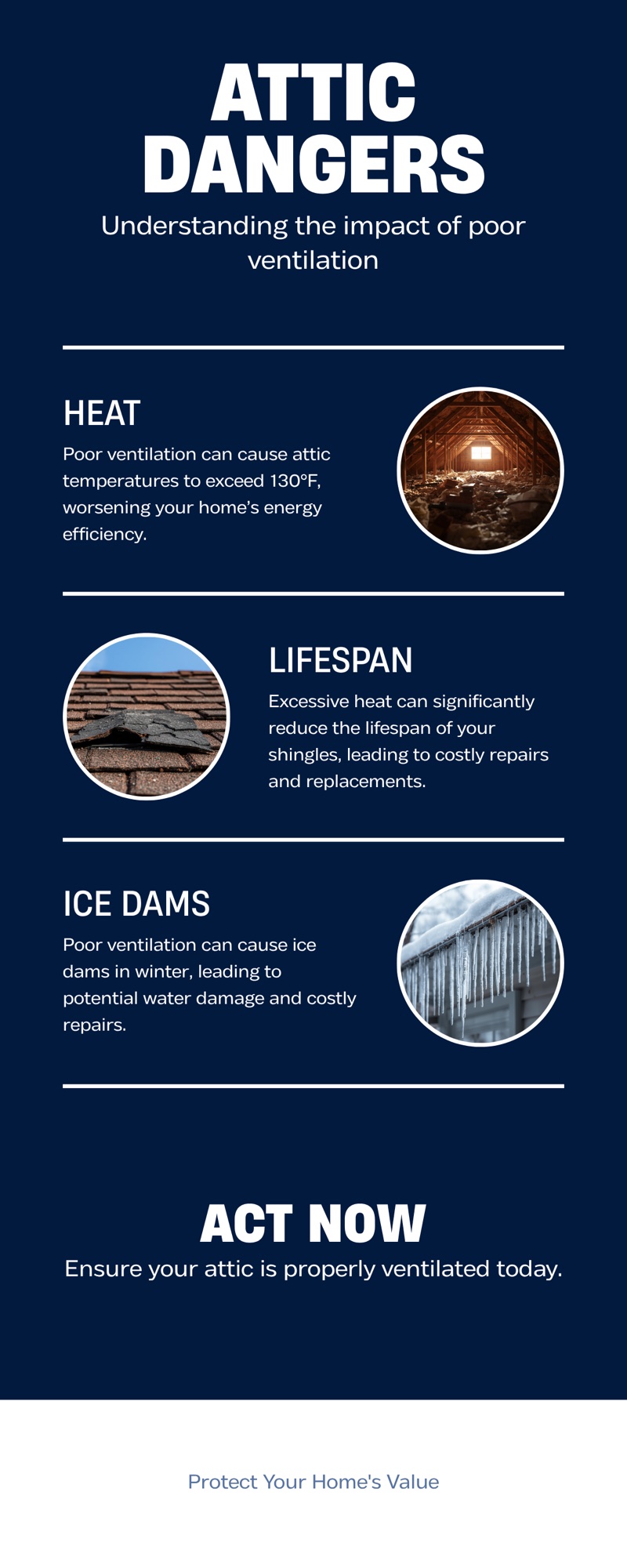
Right now — on any July afternoon in Bucks County — your attic is probably pushing 130°F. Maybe 140°F. Possibly closer to 150°F.
You can’t feel it from your living room. But your shingles can. Your AC can. And your wallet definitely can.
Most homeowners don’t think about attic ventilation until something fails — a shingle warranty gets voided, an energy bill spikes, or an ice dam tears off a gutter in January. By then the damage is already done. This guide explains what’s actually happening up there, how to spot trouble early, and what YBR does on a ventilation assessment — before peak summer heat arrives.
What July Does to a Bucks County Attic
Pennsylvania’s Climate Zone 4A (Mixed-Humid) means brutal summer heat paired with genuine humidity. An unventilated or under-ventilated attic in Bucks County can hit 130°F–150°F by mid-afternoon — more than 50°F above the outside air temperature.
Here’s what that heat is costing you:
- AC bills: That radiant heat load pushes through your ceiling into conditioned space. Your HVAC system runs longer, works harder, and wears out faster. Studies routinely show 10–25% cooling-cost reductions after proper ventilation is installed.
- Shingle life: Heat degrades asphalt shingles from underneath — not just from above. GAF, Owens Corning, and CertainTeed warranty documents explicitly cite “inadequate attic ventilation” as a basis for exclusion. A shingle rated for 30 years can lose 10–15 years of life on a hot, poorly ventilated roof.
- Structural damage: Prolonged heat and moisture exposure warps roof sheathing and degrades adhesives in OSB decking. What starts as a ventilation problem becomes a structural repair.
Deadline alert: PECO and PPL Corporation both run rebate programs for qualifying home efficiency upgrades. The current program cycle ends May 31, 2026. Solar attic fans and qualifying ventilation upgrades may be eligible. YBR can check your address against the utility territory map on your assessment call.
The Ventilation Math (What the Code Actually Requires)
The International Residential Code (IRC Table R806.2) sets the baseline: 1 square foot of net free area (NFA) for every 150 square feet of attic floor space — or 1:300 if a vapor barrier is present and venting is split evenly between intake and exhaust.
That ratio only works if the system is balanced:
- Intake vents (soffit vents at the eaves) pull cool outside air into the attic low.
- Exhaust vents (ridge vents, static vents, or powered fans at the peak) let hot air escape high.
Hot air rises. The system is designed to exploit that physics. When it’s balanced, you get a continuous airflow washing through the attic space, flushing heat and moisture out continuously.
What “unbalanced” looks like: If you have exhaust capacity but not enough intake (or vice versa), the system short-circuits. Hot pockets form. In winter, warm moist air from the living space condenses on cold sheathing — that’s where ice dams come from. The same attic that bakes in summer is also creating the conditions for ice dams in January. Both problems trace back to the same root cause.
4 Warning Signs You Can Check Right Now
You don’t need a contractor to do an initial check. Here’s what to look for from inside your attic (bring a flashlight and check on a hot afternoon for the most useful data):
1. Attic temperature more than 20°F above outside air
A properly ventilated attic should track reasonably close to outside temperature. If it’s 90°F outside and 130°F in your attic, that’s not normal — it’s a ventilation failure. Bring a simple thermometer on a hot day.
2. Ice dams forming at the eaves in winter
Ice dams form when heat escaping from the living space warms the roof deck unevenly, melting snow that refreezes at the cold eaves. They’re a winter symptom of a year-round ventilation problem.
3. Moisture staining on rafters or sheathing
Dark streaks, black discoloration, or soft spots on the underside of the roof deck indicate moisture has been condensing up there — often for months or years. This is wood rot in progress.
4. AC running constantly but the house stays hot
If your upstairs rooms never cool down despite a functioning HVAC system, the attic heat load is overwhelming your system. Proper ventilation addresses the source instead of fighting the symptom.
What YBR Does on a Ventilation Assessment
A YBR ventilation assessment is a systematic check — not a visual once-over. Here’s what we look at:
- NFA calculation: We measure your actual attic floor square footage and calculate the net free area required under IRC R806.2. Then we measure what you have. Most homeowners are surprised how far off the numbers are.
- Soffit blockage inspection: This is the #1 culprit we find. When blown-in insulation is installed, it frequently buries the soffit baffles or blocks the eave vents entirely. You can have functioning intake vents that are 80% obstructed by insulation you can’t see from outside.
- Vent type recommendation: Not all exhaust solutions are equal for every roof. We assess whether your roof is best served by continuous ridge vent, static box vents, a solar attic fan, or a powered attic fan — based on your roof geometry, current penetrations, and budget.
- Intake/exhaust balance check: We verify the split is correct so the system actually flows the way the physics requires.
Upgrade Options and Approximate Costs
Ventilation upgrades range from targeted fixes to full system overhauls. Here’s a realistic cost range for Bucks County homeowners:
| Upgrade | Approximate Cost (Installed) | Notes |
|---|---|---|
| Ridge vent addition | $300–$600 | Best exhaust solution for most sloped roofs |
| Soffit vent clearing / addition | $200–$400 | Often the highest-ROI fix; addresses intake blockage |
| Solar attic fan | $350–$800 | May qualify for PECO/PPL rebate programs |
| Electric attic fan | $350–$800 | Higher airflow capacity; requires electrical connection |
| Full ventilation upgrade | $800–$1,500 | Complete intake + exhaust system rebuild |
Solar attic fans in particular may qualify under PECO or PPL Corporation’s current rebate programs. The current cycle ends May 31, 2026. YBR can verify eligibility based on your utility territory during the assessment call.
About This Topic
| Topic | Type | Role |
|---|---|---|
| Attic Ventilation | BuildingTechnique | Topic |
| PECO | PublicUtility | Local Relevance |
| PPL Corporation | PublicUtility | Local Relevance |
| Bucks County, Pennsylvania | AdministrativeArea | Service Area |
| International Residential Code | Regulation | Standard |
Resources
- EPA Moisture Control guidance
- PECO rebate programs
- IRC Table R806.2 — Ventilation ratios (International Residential Code)
Topic Info
| Climate Zone | 4A (Mixed-Humid) — PA |
| IRC Ventilation Ratio | 1:150 (with vapor barrier) or 1:300 |
| Peak Attic Temp | 130°F–150°F (summer, unventilated) |
Frequently Asked Questions
Get a Free Attic Ventilation Assessment Before Summer
Don’t wait until your energy bills spike or your shingle warranty is in question. YBR offers a free 30-minute phone consultation to walk through what you’re seeing, what it likely means, and what it costs to fix.
Call or text: (267) 902-2393
Serving Bucks County, Montgomery County, and surrounding Pennsylvania communities