You signed a roof replacement contract, the crew tore off the old shingles, and then you got a call: the wood under the roof is rotted, and the job will cost more. Hidden roof deck damage is a frequent reason a roof replacement price changes after work starts, and for many homeowners in Bucks County, this is the most stressful moment of the whole project. It feels like a surprise, and it is easy to wonder whether you are being taken advantage of.
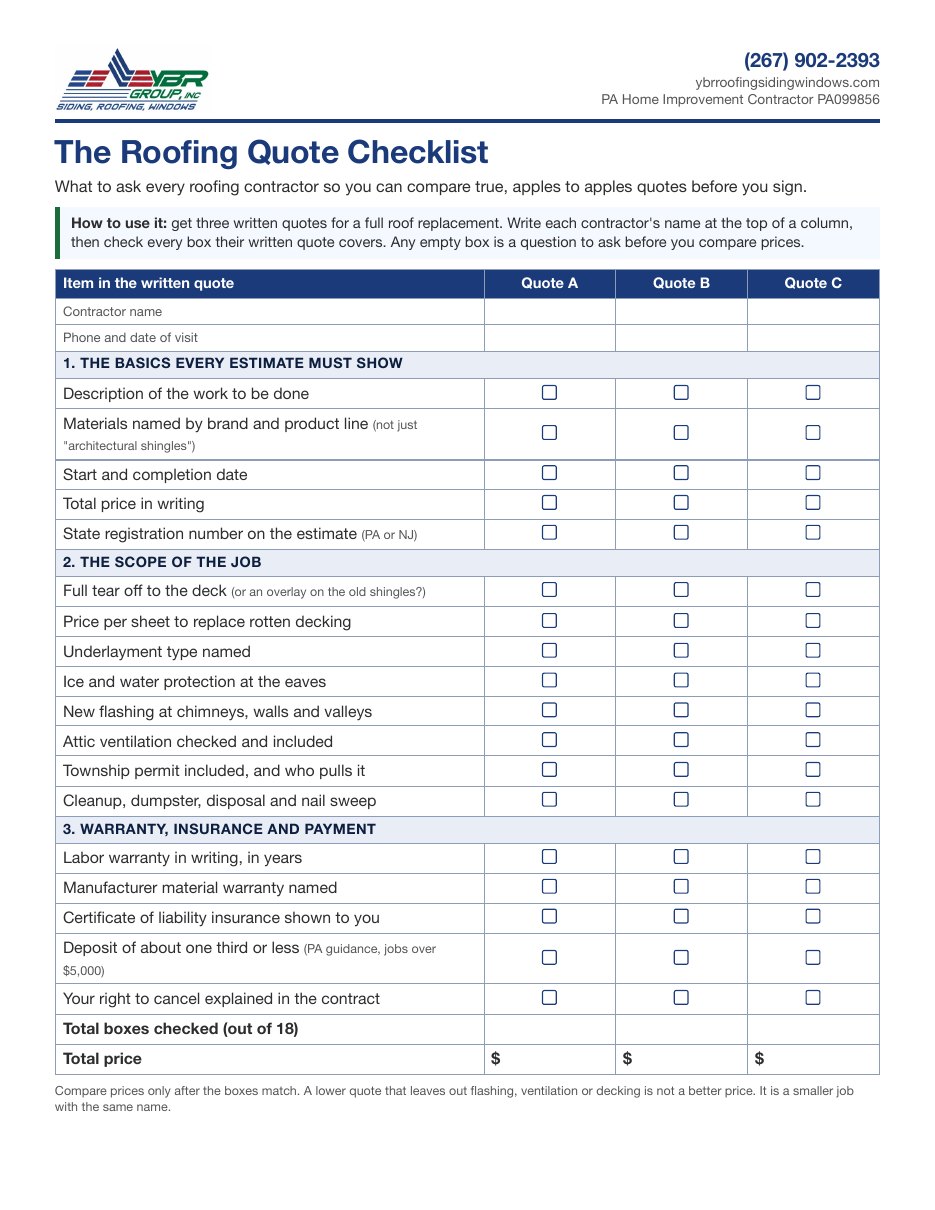
The truth is that hidden roof deck damage is a real and common part of roofing, and a change order is a normal, legitimate tool for handling it. What matters is how it is explained, documented, and priced. This guide walks through what the roof deck is, why damage hides, how change orders work, and what you should expect from an honest contractor so that nothing catches you off guard. If you are still comparing contractors, our free roofing quote checklist lists what to ask about deck repair pricing before you sign.
Call (267) 902-2393 for a Free Inspection
What the Roof Deck Is and Why It Matters
The roof deck (also called roof sheathing) is the flat wooden layer that sits on top of your rafters or trusses. Shingles, underlayment, and flashing all attach to it. Most homes in our area have deck boards made of plywood or oriented strand board (OSB), and some older homes have plank decking made of individual boards with small gaps between them.
Think of the deck as the foundation of your roof. Shingles are the visible, weather-facing layer, but they only perform well if the surface under them is flat, dry, solid, and able to hold fasteners. A shingle nail driven into soft or crumbling wood does not hold the way it should. A new roof installed over a weak deck can sag, ripple, leak at the nails, or lose shingles in strong wind.
Because the deck carries the weight of the roof system, workers, snow, and ice, its condition affects both the lifespan of the new roof and the safety of the crew standing on it. That is why a responsible contractor will not simply cover bad wood with new shingles.
Why Roof Deck Damage Stays Hidden Until Tear-Off
Homeowners often ask, “How could you not know about this before the job started?” It is a fair question, and the answer is simple: the deck is covered. From the ground, from a ladder, and even from a walk across the roof, the shingles and underlayment hide what is underneath. A deck can look flat and fine from above while the underside is stained, soft, or rotting.
Several things cause damage that cannot be seen until the old roof comes off:
- Slow leaks. A small leak around a vent pipe, chimney, or skylight can drip onto the same patch of wood for years before a stain ever appears on your ceiling.
- Condensation. Warm, moist air from the living space can rise into the attic and condense on the cold underside of the deck in winter. Over time this causes dark staining, mold, and rot. Poor airflow makes it worse, which is why attic ventilation for Bucks County roofs is so closely tied to deck health.
- Ice dams. Pennsylvania winters can push meltwater back under shingles, soaking the deck along the eaves again and again. Our winter roof prep checklist covers the warning signs.
- Storm damage. Impact and moisture from severe weather can compromise the layers below the surface. If you suspect this, read about hail damage in Bucks County to see what to look for.
- Age and previous repairs. Older roofs may have had patches, extra layers, or poor fastening that left problem spots no one documented.
- Insect or animal activity. Pests that find a way in can damage wood in places no one can see.
A good inspector can spot warning signs before tear-off, such as sagging, soft spots underfoot, water stains in the attic, or daylight showing through boards. But no one can see every inch of the deck until the shingles are gone. Honest contractors say this up front instead of promising something they cannot know. Our roof inspection checklist shows what can and cannot be checked before tear-off.
What Counts as Damage That Must Be Replaced
Not every stained board needs to be replaced, and not every repair is optional. Understanding the difference helps you judge whether a change order is reasonable.
Deck sections generally need replacement when they show:
- Rot, crumbling, or soft wood that gives way when pressed or probed
- Delamination, where plywood layers peel apart or OSB swells and breaks down at the edges
- Widespread mold or deep water saturation that has not dried
- Broken, cracked, or split boards
- Sections that are sagging or no longer hold fasteners
- Old plank decking with large gaps, missing boards, or poor spacing that will not support modern roofing materials
Surface staining or minor discoloration on solid, dry wood is often acceptable. A good contractor can show you the difference. If a board is solid and holds a fastener, it may be fine. If it crumbles or flexes, it is not.
Building codes and shingle manufacturers also set expectations for the surface under the roof. The International Residential Code adopted in Pennsylvania states in Section R905.2.1 that “asphalt shingles shall be fastened to solidly sheathed decks” (IRC 2018, Chapter 9). Shingle makers publish installation instructions, and installing over a deck that does not meet those requirements can affect warranty coverage. You can read general guidance from the National Roofing Contractors Association, an industry association that publishes roofing practices and homeowner resources.
How Change Orders Work in Roofing
A change order is a written amendment to your original contract. It records a change to the scope of work, the price, or both, and it is signed by you and the contractor before the extra work is done. It exists to protect both sides: you know exactly what is being added and what it costs, and the contractor has clear approval to proceed.
In roofing, hidden deck damage is one of the usual reasons for a change order. The original estimate is based on what can be seen and measured before the roof is opened up. Contracts often handle the unknown by including a line for deck repair priced per unit (for example, by the sheet of decking or by the linear foot of a board), with a final quantity determined at tear-off.
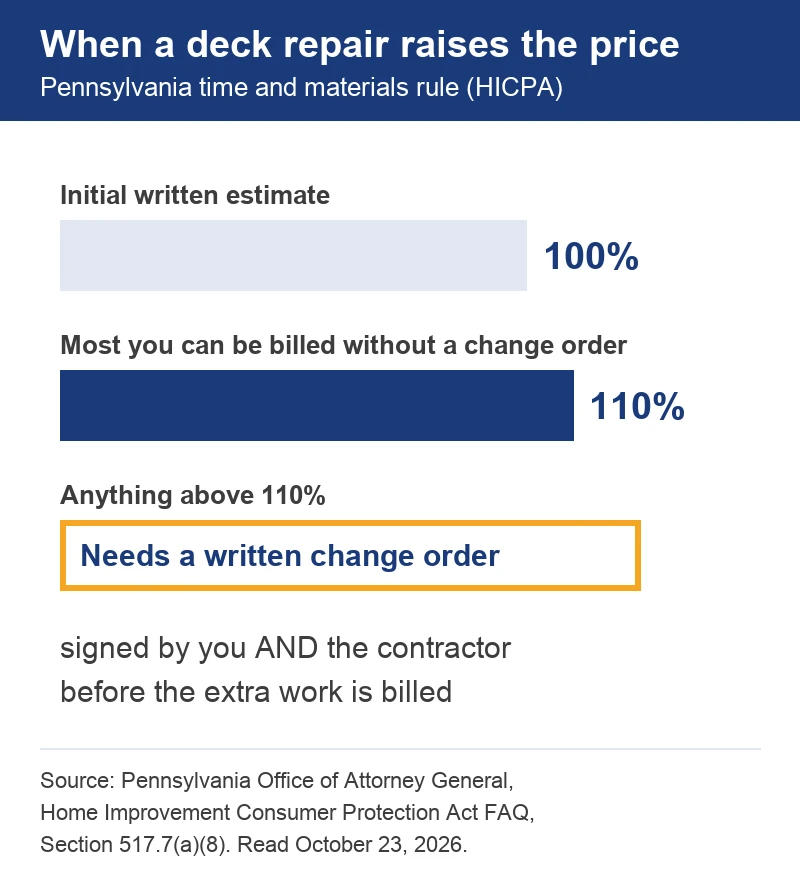
Pennsylvania law backs this up. The Pennsylvania Attorney General’s Home Improvement Consumer Protection Act FAQ says home improvement contracts over $500 must be in writing and signed by the consumer and the contractor. For time and materials contracts, the contractor must tell you in writing that the price will not exceed 10% above the initial cost estimate, and that “any cost beyond the contract price (initial cost estimate plus 10%) must be agreed to by the homeowner in a written change order.”
A solid change order should include:
- A clear description of the problem found
- The location of the damage on the roof
- The type of repair or replacement planned
- The unit price and the total cost for the extra work
- The effect, if any, on the project schedule
- Your signature and the contractor’s signature before work begins
Be cautious of any contractor who asks you to agree to added costs by phone with no written record, who refuses to explain what was found, or who sends a vague bill after the work is done. A professional change order is specific, written, and approved in advance.
How Hidden Deck Damage Costs Are Calculated
We will not quote you a price in a blog post, because every roof is different. But we can explain what drives the cost so the number makes sense when you see it.
- The amount of damaged decking. A small patch near a chimney is a very different job than a large section along an entire eave.
- The type of decking. Plywood, OSB, and plank decking each have different material and labor needs.
- Roof pitch and access. Steeper or more complex roofs take more time and safety equipment for the same repair.
- Material costs at the time of the job. Lumber and sheet goods prices move with the market.
- Fixing the cause. If damage came from a leak or poor airflow, solving that cause may be part of the work so the new deck does not fail the same way.
The most useful thing you can do is ask for the unit price in your original contract. When the price per unit is written down before work starts, a surprise at tear-off becomes a simple multiplication problem instead of a negotiation. For a broader look at budgeting, see our guide to roof replacement cost in Bucks County, and read how many roofing quotes to get so you can compare how each contractor prices deck repair.
Ways to Prepare Before the Crew Arrives
You cannot eliminate the chance of hidden damage, but you can reduce the stress it causes. A few steps make a big difference.
- Ask how deck repair is handled in the contract. Look for a stated unit price and a clear process for approval.
- Inspect your attic. With a flashlight, look for dark stains, damp insulation, rusty nail tips, or musty smells. Share what you find with your contractor.
- Set aside a cushion. Many homeowners plan for a possible deck repair so a change order is not a financial shock. If you are still deciding how to fund the project, our guide on how to pay for a roof replacement in Bucks County covers your options.
- Understand the timeline. Extra deck work can add time. Our article on how long a roof replacement takes explains the normal schedule.
- Check permit requirements. Before work begins, learn whether you need a permit for a new roof in Bucks County.
- Consider timing. Weather affects both repairs and exposure of an open deck. See the best time to replace a roof in Pennsylvania.
Our Experience Handling Roof Deck Surprises
YBR GROUP Inc has served homeowners since 2016 as a full-service exterior contractor for roof replacement, siding, and window installation in Bucks County and Southeastern Pennsylvania. Every job is a complete system rather than a patch, so our work is shaped by the same weather, older housing stock, and building conditions you deal with every day.
When you call, you talk directly with an experienced contractor, and roofing work is handled by our own team rather than subcontractors. Inspections and quotes are free, and in most cases you get a quote the same day. That matters when decking turns out to be damaged: the team that opened your roof is the team that explains what was found, why it needs attention, and what it means for your project, in writing.
If you are budgeting for other upgrades at the same time, our guide on paying for a roof replacement walks through financing and timing.
Questions to Ask Your Contractor About Deck Damage
Whether you hire us or someone else, and whether you book a roofing contractor site visit with us or another company, these questions help you protect yourself and keep the project fair.
- How is damaged decking priced in this contract, and is the unit price written down?
- How will I be told if damage is found, and will I see photos or the damage itself?
- Will I sign a written change order before any extra work begins?
- What will you do to fix the cause of the damage, not only replace the boards?
- How would extra deck work affect the schedule?
- Does the warranty cover the new decking and the roof system over it?
A contractor who answers these clearly and calmly is usually one who has handled hidden damage many times. A contractor who dodges them is a warning sign worth taking seriously.
Talk to YBR GROUP Inc about your situation.
Frequently Asked Questions
Is it normal for a roofer to find extra damage after tear-off?
Yes. The deck is covered by shingles and underlayment, so even an experienced inspector cannot see all of it before the old roof comes off. Finding some damaged decking is a common part of roof replacement, especially on older homes or roofs with past leaks.
Can a contractor charge me for deck repair without my approval?
A professional contractor should not. Extra work should be described in a written change order with the price, and you should approve it before the work is done. If your contract lists a unit price for deck repair, the change order simply confirms the quantity found.
Can I skip the deck repair to save money?
That is risky. Shingles need a solid, dry surface to hold fasteners and lie flat. Covering rotted or weak decking can lead to leaks, sagging, and early roof failure, and it may affect manufacturer warranty coverage. A good contractor will show you what needs replacing and what can safely stay.
How can I tell if my roof deck might be damaged before the job?
Warning signs include a sagging roofline, soft spots when walked on, water stains on ceilings, damp or stained wood in the attic, a musty smell, and past leaks. These signs do not prove damage, but they tell you to ask your contractor how deck repair will be handled.
Does attic ventilation affect roof deck damage?
Yes. Poor airflow lets moisture build up under the deck, which can cause mold and rot over time. Good ventilation helps keep the deck dry, so it is worth checking when you replace your roof.
If you are planning a roof replacement or worried about what may be hiding under your shingles, call (267) 902-2393 or get in touch with YBR GROUP Inc. We will inspect your roof for free, explain how deck damage and change orders are handled in writing, and answer your questions before any work begins.