Quick Answer
Most Bucks County homeowners complete a roof or siding insurance claim in 4–8 weeks from storm date to payment. Here’s the step-by-step.
A severe storm rolls through Southampton or Warminster, hail pounds your roof, and by morning you’re staring at damaged shingles, dented siding panels, and a sinking feeling about what comes next. Filing a homeowners insurance claim for roof or siding damage is one of the most stressful parts of storm recovery — not because the process is impossible, but because most homeowners have never done it before and don’t know what to expect.
This guide walks you through every step: what triggers a valid claim, how to document damage, how to handle the adjuster visit, and — critically — how to avoid the most common mistakes that cost Bucks County homeowners thousands of dollars in denied or underpaid claims.
What Triggers a Roof or Siding Insurance Claim in Bucks County
Homeowners insurance covers sudden, accidental storm damage — not gradual wear and tear. In Bucks County and the surrounding SE Pennsylvania region, the most common triggers are:
Hail Damage
Hail is the primary driver of roof and siding insurance claims across Pennsylvania. SE Pennsylvania averages 3–5 significant hail events per year. Even quarter-sized hail (1 inch) can crack asphalt shingles, fracture fiberglass mat, and dent aluminum or vinyl siding. The damage is often invisible from the ground but creates entry points for water infiltration that worsen every season. If your area was hit, learn what hail damage looks like on Bucks County roofs and how to document it.
Wind Damage
Summer thunderstorms in Bucks County regularly produce gusts of 60 mph or higher. At those speeds, shingles lift, tabs crack, flashing pulls away from chimneys and valleys, and siding panels can separate at the seams. Wind damage is particularly common on ridge lines, rakes, and the windward faces of the home.
Ice Dam Damage
Every February and March, Bucks County homeowners deal with ice dams — ridges of ice that form along eaves when attic heat melts snow unevenly. As water backs up behind the dam and seeps under shingles, it causes interior ceiling damage, rotted decking, and failed underlayment. Ice dam damage is a covered peril under most standard homeowners policies when caused by the freeze-thaw cycle, not by a maintenance failure.
Fallen Tree Damage
Storm-felled trees and large limbs are a covered cause of loss for both roof and siding damage. Even branches that don’t penetrate the roof can cause significant impact damage to shingles, gutters, and siding panels that qualifies for a full insurance claim.
Important: What Is NOT Covered
Normal wear and tear, aging shingles, granule loss from age, and deferred maintenance are not covered by homeowners insurance. Only sudden storm events qualify. If your roof is 20+ years old, your insurer may apply significant depreciation — we cover that below under ACV vs. RCV.
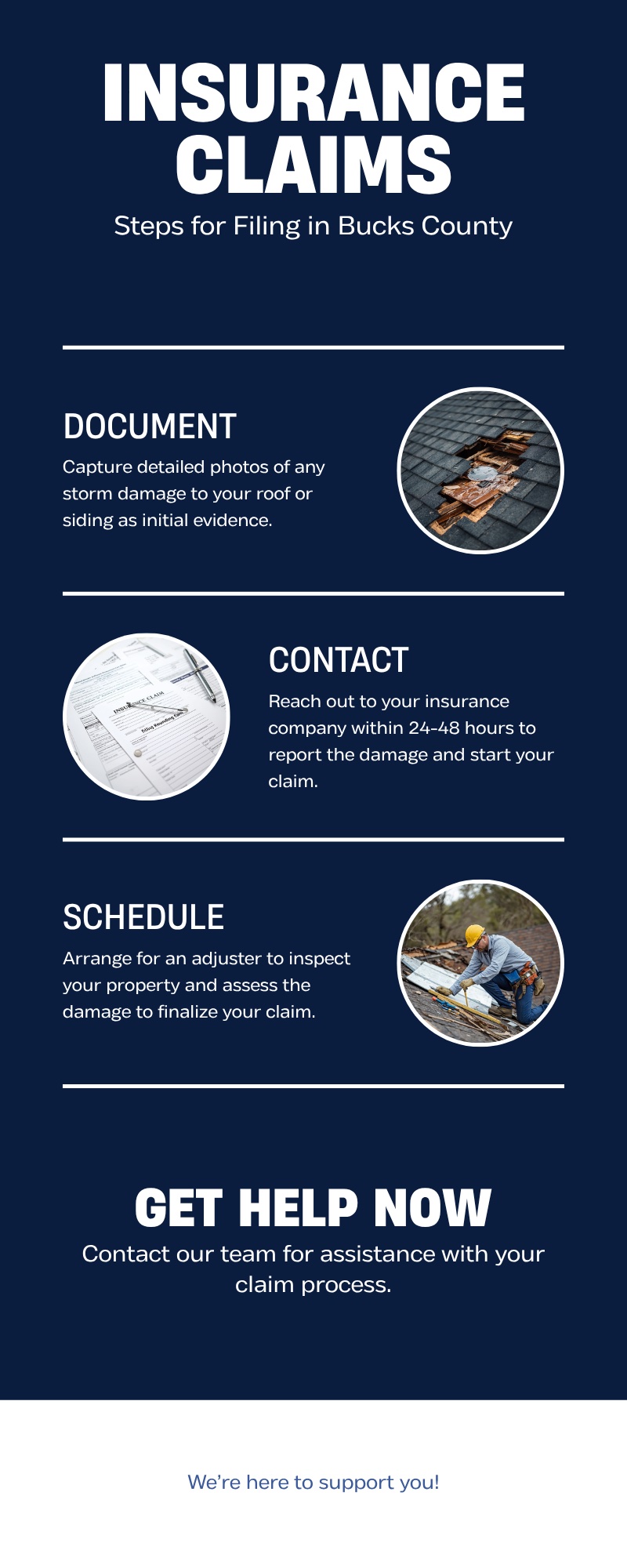
Step-by-Step: Filing a Roof or Siding Insurance Claim
Step 1 — Document the Damage Before Touching Anything
Before you clear debris, tarp anything, or make any temporary repair, document everything with photos and video. Your claim’s credibility depends on this evidence.
Photograph and video:
- Interior damage — water stains, ceiling bubbles, wet insulation, damaged walls
- Exterior from the ground — visible shingle damage, missing tabs, dented gutters, siding impacts
- Any debris on the roof, in gutters, or in the yard (hail stones, branches)
- Date-stamped photos on your phone — do not edit or filter them
Do NOT Make Repairs Before the Adjuster Visits
Performing repairs before the insurance adjuster inspects the damage may give the insurer grounds to dispute the scope or void portions of your claim. Emergency tarping to prevent further damage is generally acceptable — document it thoroughly. But hold off on any permanent repairs until after the adjuster visit.
Also note the storm date and approximate time. Check local news archives or weather apps for reports of the storm — National Weather Service records, local news storm reports, and even neighborhood social media posts can all support your claim if the insurer questions whether a qualifying event occurred.
Step 2 — Call Your Insurance Company Within 24–72 Hours
Most Pennsylvania homeowners insurance policies require prompt notification of a covered loss. While PA law gives you time to file, waiting weeks or months can complicate your claim — adjusters will question whether damage is truly storm-related if significant time has passed.
When you call your insurer:
- Get a claim number — write it down immediately and keep it on every piece of correspondence
- Ask: “What is the deadline for submitting a contractor estimate?”
- Ask: “When will an adjuster contact me to schedule the inspection?”
- Ask: “Does my policy have an ACV or RCV provision?” (explained in detail below)
Step 3 — Get an Independent Contractor Estimate BEFORE the Adjuster Visits
This is the step most homeowners skip — and it costs them. The insurance adjuster works for the insurance company. Their job is to accurately scope the damage, but their estimate ultimately protects the company’s interests, not yours.
Having your own written contractor estimate before the adjuster visit gives you a baseline to compare against the insurer’s scope of loss. As a licensed roofing and siding contractor serving Bucks County since 2016, YBR GROUP provides detailed pre-adjuster estimates at no cost. Contact us at (267) 902-2393 to schedule.
Your estimate should be itemized, including:
- Materials (shingles, underlayment, ice-and-water shield, siding panels, trim)
- Labor (tear-off, installation, cleanup)
- Permit fees (required in most Bucks County townships before work begins)
- Disposal fees
You can also review the Bucks County contractor guide to understand what a complete estimate should include and how to vet contractors before the adjuster arrives.
Step 4 — The Insurance Adjuster Visit
The adjuster will typically inspect the roof surface, flashing, gutters, siding panels, and any visible interior damage. They’ll generate a Scope of Loss document that lists every line item they’re approving for payment.
What adjusters often miss or undervalue:
- Ice-and-water shield replacement (often omitted even when required by PA building code)
- Underlayment replacement (frequently priced at minimal quantities)
- Interior damage from water infiltration (may require a separate interior inspection)
- Ventilation components, ridge caps, and starter strips damaged in the same event
- Siding that can’t be color-matched — PA policies may require full-side replacement for uniformity
You have the right to be present during the adjuster inspection. Walk the perimeter with them. If your contractor is available, have them present — an experienced roofer can point out damage the adjuster might overlook. This is not obstruction; it’s your right as the policyholder.
Step 5 — Review the Adjuster’s Scope of Loss
When you receive the adjuster’s Scope of Loss, compare it line-by-line to your contractor’s itemized estimate. The two documents rarely match perfectly — and the differences matter.
Key things to look for:
- ACV vs. RCV: Is the insurer paying actual cash value (depreciated) or replacement cost value (full replacement)? This is the single most important number. See the full explanation below.
- Depreciation holdback: Your insurer typically pays ACV now, then releases the withheld depreciation (the “holdback”) after work is completed and you submit the final invoice. Do not skip this step — it can represent 20–40% of the total claim value.
- Missing line items: If your estimate includes ice-and-water shield and the adjuster’s scope doesn’t, that’s a discrepancy to dispute.
If the estimates don’t align, you have two options: request a re-inspection (submit a written request with your contractor’s estimate attached) or invoke the appraisal clause in your policy, which allows both parties to hire independent appraisers to resolve the dispute. Most policies include this provision — check your declarations page.
Also check the typical roof replacement costs in Bucks County so you understand whether the insurer’s numbers reflect actual market rates for materials and labor in our area.
Step 6 — Permits, Work, and Final Claim Payment
Once the scope is agreed upon, work can begin — but only after the required permit is pulled. In most Bucks County townships, a roofing or siding permit must be obtained before work starts. This applies whether you’re in Warminster, Doylestown, Newtown, or any other township in the county.
Many insurers require the permit number before releasing the final depreciation payment. Keep all of the following:
- Your contractor’s signed final invoice
- Copy of the building permit (your contractor should provide this)
- Certificate of completion or inspection sign-off from the township
- All receipts for supplemental materials
Submit these to your insurer promptly after project completion to trigger the depreciation release (your final payment). Do not let this step sit — most policies have a window for submitting completion documentation.
Common Claim Mistakes Bucks County Homeowners Make
- Waiting too long to file. Most PA homeowners policies have a 1-year window from the storm date to file a claim. Miss it and the claim is denied regardless of legitimate damage.
- Accepting the first adjuster estimate without dispute. The first estimate is a starting point, not a final number. Adjusters are human and miss things — especially interior damage, underlayment costs, and code-required upgrades.
- Hiring a contractor who promises to “work with your insurance” to cover your deductible. If a contractor offers to waive or absorb your deductible in exchange for the insurance work, walk away. This is insurance fraud in Pennsylvania and can invalidate your entire claim.
- Missing the supplement window. If your contractor finds additional damage during the work (hidden wood rot, failed decking, improper previous repairs), this can be submitted as a supplement to the original claim. You typically have 90–180 days after the original payment to submit supplements — ask your insurer for the exact window.
- Confusing maintenance items with storm damage. A cracked, aged shingle from years of UV exposure is not storm damage. Adjusters are trained to distinguish these. If your roof is old and already deteriorated, expect partial coverage and depreciation deductions even if the storm caused some incremental damage.
ACV vs. RCV — The Most Important Coverage Question
This single distinction can mean a difference of thousands of dollars in what your insurer actually pays out.
ACV — Actual Cash Value
The insurer pays the current depreciated value of your roof. A 20-year-old asphalt shingle roof with a 25-year lifespan may be depreciated 80%. If replacement costs $18,000, you might receive $3,600 — minus your deductible. You pay the rest out of pocket.
RCV — Replacement Cost Value
The insurer pays the full cost to replace with like kind and quality. You receive ACV upfront, then the withheld depreciation is released after work is complete. RCV policies cost more in premiums but protect you fully against catastrophic storm loss.
How to check your coverage: Look at your policy declarations page. If it says “Replacement Cost Value” or “RCV,” you have full replacement coverage. If it says “Actual Cash Value” or “ACV only,” you are underinsured for a major roof or siding claim and should speak with your agent about upgrading your coverage before the next storm season.
Even with an RCV policy, remember: the depreciation holdback is only released after the work is completed and documented. Never walk away from a claim thinking the first check is all you’ll receive — submit completion documents promptly.
Insurance Claim FAQ — Bucks County Homeowners
Does homeowners insurance cover roof replacement in Pennsylvania?
Generally yes, if the damage was caused by a covered storm event such as hail, wind, ice, or a fallen tree. Normal wear and tear, aging, and deferred maintenance are not covered. The amount your insurer pays depends heavily on your policy — ACV policies pay only the depreciated value of your existing roof, while RCV policies pay the full cost to replace it with like materials.
How long does an insurance claim take for a roof in Bucks County?
A typical roof insurance claim in Bucks County takes 4–8 weeks from the storm date to final payment. PA insurance law requires insurers to acknowledge a claim within 10 days of receipt and to make a coverage decision within 15 business days. If your claim is disputed or requires a re-inspection, add another 2–4 weeks. The final depreciation payment is released only after the work is completed and documented, which adds additional time.
Can I use any contractor for an insurance roof claim in Bucks County?
Yes. You are not required to use your insurance company’s preferred or recommended contractor. As a policyholder, you have the right to hire any licensed Pennsylvania contractor of your choosing. In fact, using your insurer’s preferred vendor can sometimes result in a lower-quality job scoped to minimize cost rather than fully restore your home. Always verify your contractor is licensed and insured in PA before signing any agreement.
What if my adjuster’s estimate is lower than the contractor’s estimate?
Request a line-by-line comparison and submit a written dispute with your contractor’s itemized estimate attached. If the insurer’s adjuster and your contractor cannot reach agreement on the scope, your policy’s appraisal clause allows both parties to appoint independent appraisers and, if necessary, a neutral umpire to resolve the dispute. Pennsylvania insurance regulations (PA Title 31) require fair and prompt handling of disputed claims. Document all communications in writing and save every email and letter.
Storm Damage? Get a Free Estimate Before Your Adjuster Arrives.
YBR GROUP Inc. is a licensed roofing and siding contractor based in Southampton, Bucks County. We’ve helped homeowners navigate insurance claims since 2016 — no pressure, no gimmicks, just honest scopes and quality work.