Knowing how to read a roofing estimate puts you in control before you sign. A roofing estimate can look simple at first glance: a few lines of text, a total at the bottom, and a signature box. The details between the header and the total decide whether your project goes smoothly or turns into a string of surprise charges. Two estimates for the same roof can look very different on paper, and the cheaper looking one is not always the better deal.
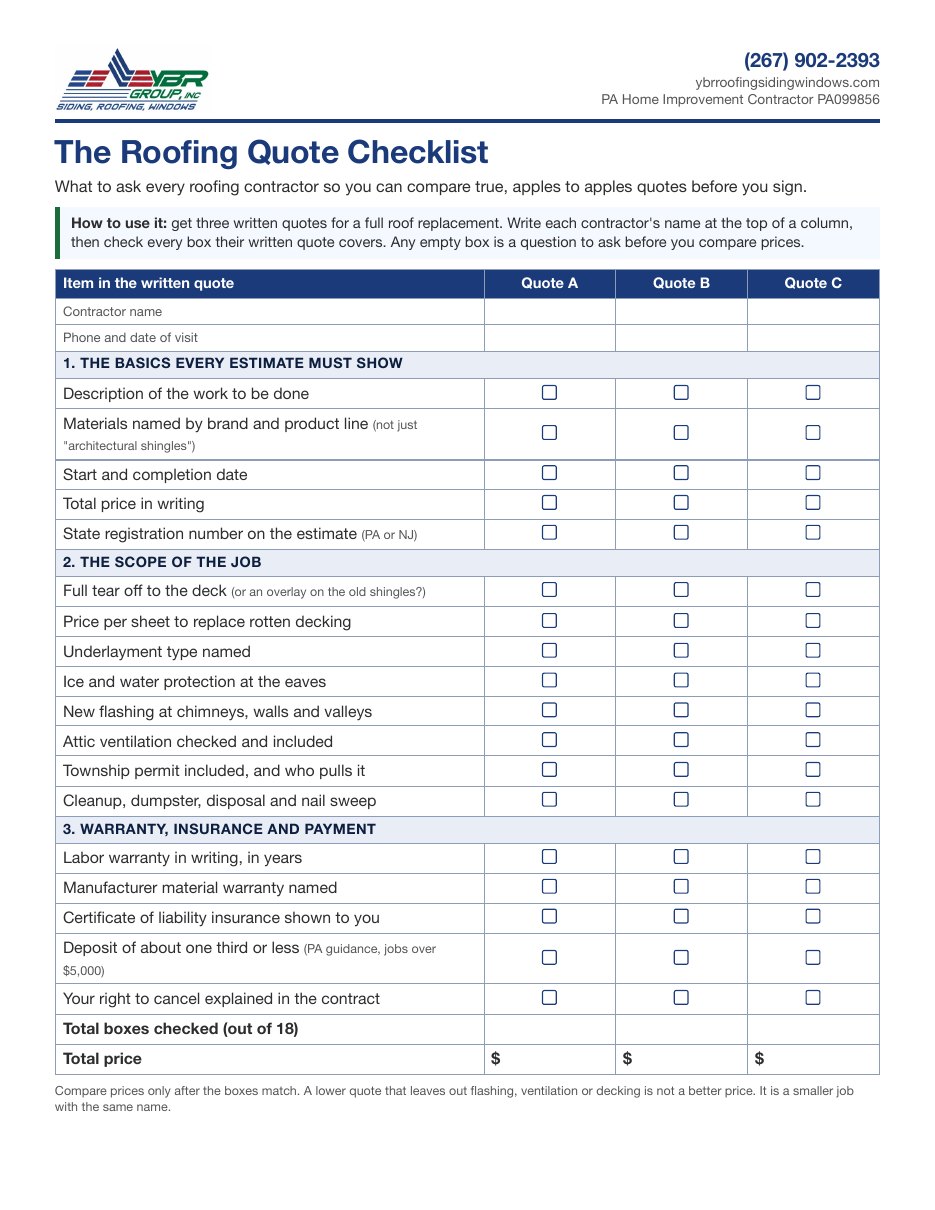
This guide walks through a typical roofing estimate from top to bottom. Use it as a checklist when you compare bids, alongside our free printable roofing quote checklist. If an estimate leaves you with questions, that is normal. A good contractor expects them and answers them plainly.
Call (267) 902-2393 for a Free Estimate
Start With the Header: Who, Where, and What Exactly
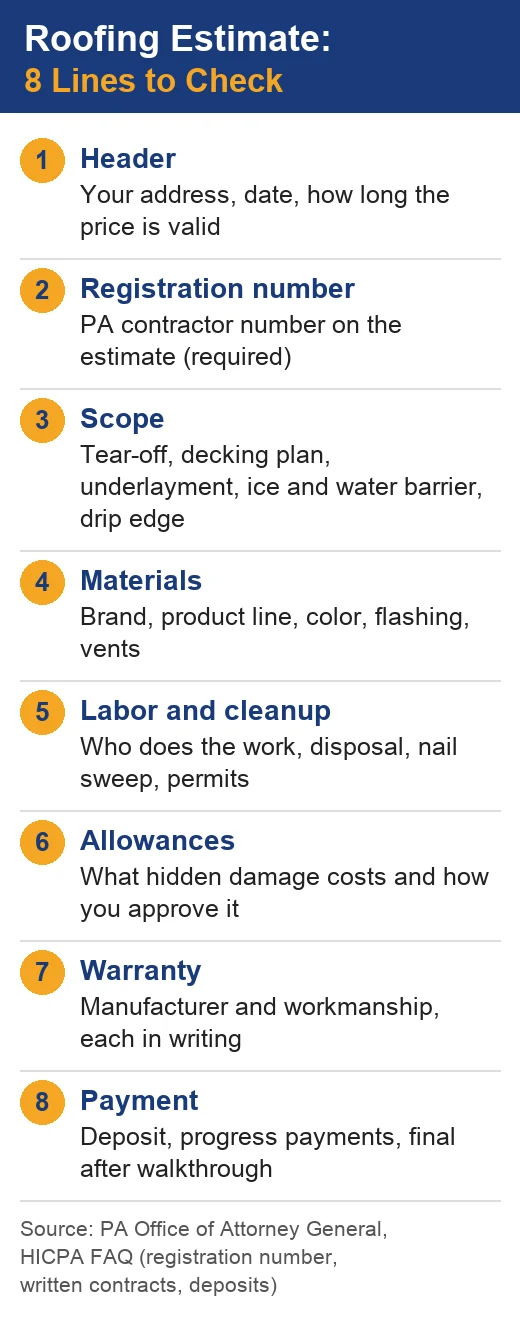
Before you look at a single price, read the top of the document. This section should be boring, and that is a good sign. It should include:
- The contractor’s full legal business name, address, phone number, and email
- The contractor’s Pennsylvania home improvement registration number
- Your name and the address of the property being worked on
- The date the estimate was written and how long the pricing stays valid
- A short description of the project, such as a full tear-off and replacement
The registration number is not optional. The Pennsylvania Office of Attorney General states that contractors “must include their registration number in their advertisements, contracts, estimates and proposals,” written as “PA” followed by the number. You can look up any contractor on the state’s home improvement contractor search. YBR GROUP Inc is registered as PA099856.
The validity date matters more than most people realize. Material costs move, and a price that is good for a limited window protects both sides. If there is no date at all, ask. Also check that the scope description matches what you discussed during the roofing contractor site visit. If you talked about replacing the entire roof and the estimate describes something smaller, stop and clarify before going further.
The Scope of Work: Tear-Off, Decking, and Underlayment
The scope of work is the heart of the estimate. It lists what the crew will actually do on your roof, and it is where vague wording hides the biggest differences between bids. Look for these items and make sure each one is spelled out.
- Tear-off: Does the price include removing the old roofing down to the deck? Some bids quietly plan to install new material over old layers, which can hide problems and add weight.
- Decking: The wood sheathing under your roofing is often in good shape, but sometimes sections are rotted or damaged. A fair estimate explains how damaged decking will be handled and priced if found, rather than ignoring it.
- Underlayment: This is the protective layer between the deck and the visible roofing. The estimate should name the type, not just say “felt” or “synthetic” in passing.
- Ice and water protection: Bucks County winters bring freeze and thaw cycles and the ice dams that come with them. Ask where self adhering membrane will be installed, such as eaves, valleys, and around penetrations.
- Drip edge and starter strips: These small parts protect the edges of your roof. Their absence from a bid is at least a question to ask.
The more specific the scope, the less room there is for misunderstanding. If a line reads “install new roof” with nothing else, request a more detailed breakdown in writing.
Materials: Brand, Product Line, and Color
The materials section tells you what will be on your home for years to come. A good estimate names the manufacturer, the specific product line, and the color. “Architectural shingles” alone is not enough, because there is a wide range of quality and warranty coverage within that category.
When you compare bids, make sure you are comparing the same thing. One estimate might price a basic shingle line while another prices a premium line, and the totals will differ for that reason alone. The same applies if you are weighing a different material altogether. Our guide on metal roofing vs asphalt shingles in Pennsylvania explains how the two compare on lifespan, upkeep, and cost, and our page on metal roofing in Bucks County covers what that option looks like for local homes.
Also look at the materials line for flashing, vents, and fasteners. Flashing is the metal that seals joints around chimneys, skylights, walls, and valleys, and it is where many leaks begin. An estimate that lists new flashing is describing a more thorough job than one that reuses old pieces.
Labor, Cleanup, and Disposal
Labor is often bundled into one line, and that is fine as long as the scope above it is detailed. What you want to confirm here is who is doing the work and how it is managed. Ask whether the crew are the contractor’s own team or subcontractors, and who will be on site supervising.
Then look for the lines that people forget until the job is underway:
- Debris removal: Is a dumpster or haul away included? Old roofing is heavy and bulky.
- Magnetic sweep: Roofing nails scatter during tear-off. A magnet sweep of the yard and driveway protects your tires and your family.
- Property protection: Tarps over landscaping, protection for siding and windows, and care around gutters all belong in a professional job.
- Permits: Some municipalities require a permit for roof replacement. The estimate should say who pulls it and whether the fee is included.
If any of these are missing, it does not automatically mean the contractor will skip them. It means you should ask and get the answer written down.
Allowances, Exclusions, and Change Orders
This is the section where cheap looking estimates tend to reveal their catch. An allowance is a placeholder amount for something that cannot be known until work begins, most commonly rotted decking or hidden damage. Allowances are normal and honest when they are explained. They become a problem when they are vague or unrealistically low, because the real cost lands on you later.
- What exactly is the allowance for, and how will extra work be measured and priced?
- Will I be told before additional work is done, and will I approve it in writing?
- What is specifically not included, such as gutters, chimney work, skylights, or interior drywall?
A change order is a written agreement to alter the scope or price after the contract is signed. Every legitimate change should go through one. Pennsylvania law backs this up for time and materials contracts: according to the Attorney General, any cost beyond the initial cost estimate plus 10% “must be agreed to by the homeowner in a written change order.” If a contractor suggests handling extras with a verbal “we will sort it out,” ask for paper. Reading about common roofing problems and how experts fix them will help you recognize which issues tend to show up once the old roof comes off.
Warranty, Payment Terms, and the Contract
Two Kinds of Warranty
Warranties come in two kinds, and they are easy to confuse. The manufacturer warranty covers the material itself. The workmanship warranty comes from the contractor and covers installation errors. The estimate should state who backs each one and for how long. If a length of time is not written down, treat it as not promised.
Deposits and Payment Schedule
Next, read the payment schedule. The Pennsylvania Attorney General notes that the law limits deposits on projects over $5,000, and that “generally speaking a down payment of one-third of the total contract price or one-third plus the cost of special ordering materials is appropriate.” For the balance, the same guidance suggests “incremental payments as work progresses, with a final payment upon completion.” Be cautious about any request for the full amount up front.
What the Contract Itself Must Show
Once you choose a bid, the estimate becomes a contract. The Attorney General states that contracts for home improvements of more than $500 must be in writing, signed by both sides, and include a description of the work, an approximate start and completion date, the total price, and notice of your right to cancel. Confirm the contract matches the estimate you compared. If a replacement is on the table, how long a roof replacement takes in Bucks County, PA will help the schedule make sense.
Tax Credits and Rebates
Some estimates mention energy tax credits. Check the date: the IRS states that the Energy Efficient Home Improvement Credit applies to “improvements made through December 31, 2025” (IRS, Energy Efficient Home Improvement Credit). Our PA energy rebates guide for Bucks County covers the programs that are current.
Red Flags and a Simple Comparison Method
Once you have two or three estimates in hand, lay them side by side and compare them line by line rather than by the total. Our guide on how many roofing quotes to get explains why three is the common standard. These warning signs deserve a closer look:
- A single lump sum price with no breakdown of scope or materials
- No PA registration number anywhere on the estimate
- Missing brand or product names for shingles, underlayment, or flashing
- No mention of tear-off, disposal, or cleanup
- Pressure to sign immediately or a “today only” discount
- A deposit request well above one third of the price
- Vague or absent warranty terms
- A price far below the others with no explanation for the gap
To compare fairly, make a simple table with the same rows for each bid: tear-off, decking plan, underlayment, ice and water protection, roofing product, flashing, ventilation, cleanup, permits, warranty, and payment schedule. Wherever a cell is blank, call and ask. For a sense of what the totals should look like, see our roof replacement cost guide for Bucks County.
How YBR GROUP Inc Writes Its Estimates
YBR GROUP Inc has served homeowners in Bucks County and Southeastern Pennsylvania since 2016, with roofing, siding, and window projects handled directly by our own team, with no subcontractors. When you call, you talk directly with an experienced contractor. We inspect, answer your questions, and explain options, and you receive a quote, the same day in most cases. Inspections, quotes, and consultations are free, with no obligation and no pressure.
We carry $1,000,000 in general liability coverage, and our registration number, PA099856, is on every estimate. As one customer, Alex O., wrote in a March 2026 Google review: “The crew arrived exactly when scheduled and kept the project moving efficiently without delays.” If you already have an estimate from another company, we are glad to review it with you line by line.
For more on picking the right company, read choosing a roofing contractor in Bucks County, PA and our Bucks County contractor guide. We also serve nearby communities, including Chester, PA and Norristown, PA.
Call (267) 902-2393 Get in touch
Frequently Asked Questions
Should a roofing estimate be in writing?
Yes. A written estimate records the scope, materials, price, and terms in one place, and verbal promises are hard to prove later. In Pennsylvania, the contract for any home improvement over $500 must be in writing and signed by both sides, and the contractor’s registration number must appear on estimates.
Is the lowest roofing estimate the best choice?
Not necessarily. A lower total can mean less material, a thinner scope, skipped steps like new flashing or proper cleanup, or weaker warranty terms. Compare the line items first. If one bid is much lower than the rest, ask the contractor to explain exactly what is different.
What does an allowance on a roofing estimate mean?
An allowance is a budgeted amount for work that cannot be fully known in advance, such as replacing rotted decking once the old roofing is removed. A good estimate explains what the allowance covers, how extra work will be priced, and that you will approve any added cost in writing first.
How much deposit can a roofer ask for in Pennsylvania?
The Pennsylvania Attorney General says the law limits deposits on projects over $5,000, and that a down payment of one third of the total price, or one third plus the cost of special order materials, is generally appropriate. The balance is usually paid in stages as work progresses.
Can a roofing estimate change after I sign?
The price should only change through a written change order that you agree to, usually because hidden damage is found or you request a different scope. Make sure the process for changes is described in the contract before you sign.
If you have an estimate in hand and want a second set of eyes, or you are ready to start fresh, call (267) 902-2393 or get in touch to schedule a free inspection for your roof, siding, or windows in Bucks County and the surrounding Southeastern Pennsylvania area.