If your roof is due for replacement, you have probably already heard the two options that come up most often: metal roofing and asphalt shingles. Both are legitimate choices, and both are installed on thousands of Pennsylvania homes every year. The right answer depends on your budget today, how long you plan to stay in the house, your energy goals, and the specific conditions your roof faces in southeastern Pennsylvania. This guide walks through every major difference so you can have an informed conversation before a single shingle or panel goes up.
Why Pennsylvania’s Climate Makes This Decision More Important Than You Think
Southeastern Pennsylvania does not have a gentle climate. Bucks County and the surrounding region experience hot, humid summers, hard freezes, ice storms, nor’easters, and occasional wind events that push past the speeds most homeowners expect their roofs to handle. Your roof is not just decorative. It is a weather barrier that works 24 hours a day, every season, for as long as you own the home.
Asphalt shingles have been the dominant roofing material in this region for decades, and there is a reason for that. They are affordable, widely available, and familiar to every roofing crew in the area. But metal roofing has grown steadily in residential use because Pennsylvania homeowners are asking harder questions about long-term performance and energy costs, especially with utility rates where they are today.
Both materials behave differently under freeze-thaw cycles. Ice damming is a real concern in this region, and proper attic ventilation is critical regardless of which material you choose. A roof that is not ventilated correctly will underperform no matter what it costs.
Upfront Cost: Asphalt Shingles Win the Short Game
There is no polite way to soften this: metal roofing costs more upfront than asphalt shingles. The gap in material and installation costs is meaningful, and for homeowners working within a tight budget, asphalt shingles remain a practical and sensible choice.
Asphalt shingles come in a wide range of grades. Three-tab shingles are the most affordable entry point. Architectural (also called dimensional) shingles cost a bit more but perform better and look better on most homes. Premium designer shingles mimic the look of slate or wood shake and carry a higher price tag. If you want to understand which grade makes sense for your home, this breakdown of asphalt shingle types for Bucks County homes covers the differences clearly.
Metal roofing, by contrast, involves higher material costs and a more specialized installation. Standing seam metal and exposed-fastener steel panels are the two most common residential options. The labor for metal is more involved because panels must be measured, cut, and fastened with precision. Mistakes on a metal roof are harder to correct than mistakes on a shingle roof.
The counterargument to upfront cost is lifespan, which we will cover next. But if you need a roof now and your budget has a firm ceiling, asphalt shingles are not a compromise. They are a real roofing solution that serves Pennsylvania homes well.
Lifespan and Long-Term Value: Where Metal Earns Its Price
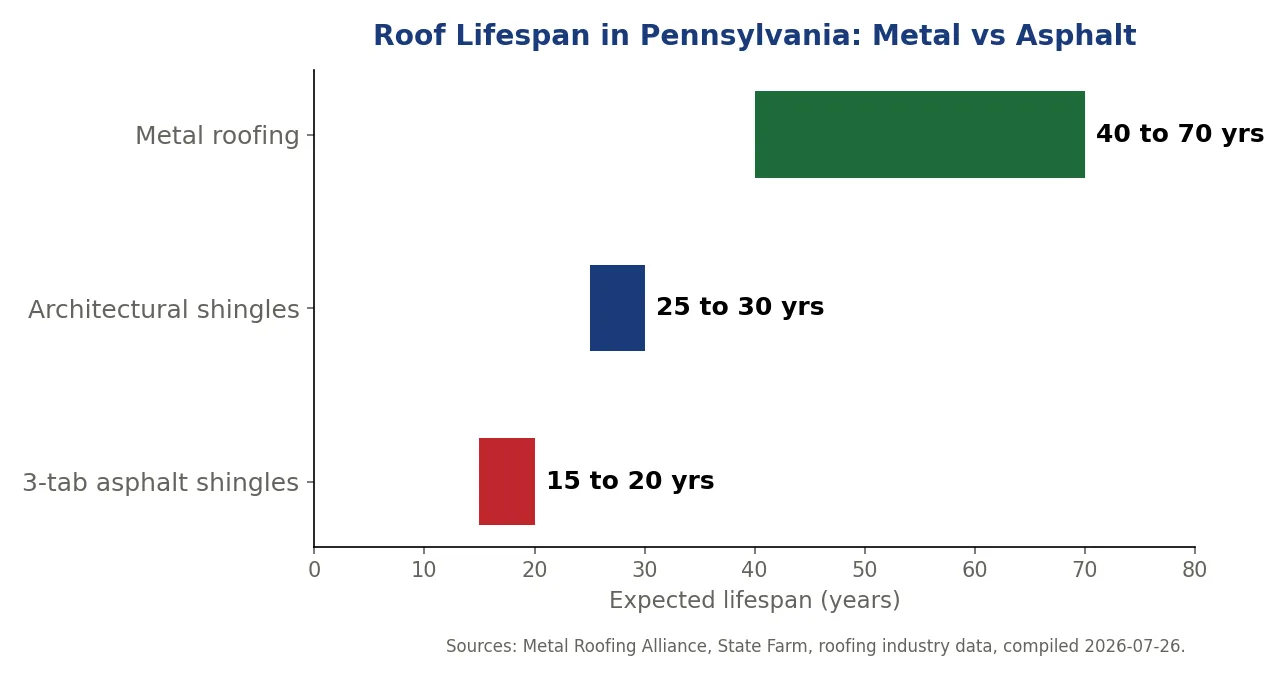
Here is where the math starts to favor metal for homeowners who plan to stay in place. A standard three-tab asphalt shingle roof in Pennsylvania might last 15 to 20 years under normal conditions. Architectural shingles are typically rated for 25 to 30 years, though actual performance varies based on ventilation, attic conditions, and installation quality. Premium shingles can carry 50-year manufacturer warranties, though the performance warranty terms are worth reading carefully.
Metal roofing, when properly installed, is commonly expected to last 40 to 70 years depending on the material, a range cited by both the Metal Roofing Alliance and State Farm. Steel panels with quality coatings, aluminum, and standing seam systems are all designed to outlast multiple asphalt shingle cycles. That means a homeowner who installs metal today may never need to replace that roof again.
The calculation becomes clearer when you consider that replacing an asphalt roof twice or three times over the same period carries its own labor and disposal costs each time. If you are trying to figure out the best time to replace your roof in Pennsylvania, the age and condition of your current material is the starting point.
For homeowners who are selling within five years, the upfront premium on metal may not be recaptured in the sale price. For homeowners who are staying, it very often is, especially when combined with energy savings.
Energy Performance and 2026 Rebate Opportunities
This is where the conversation gets practical in a way that directly affects your household budget. Metal roofing, particularly products with ENERGY STAR certification, reflects solar heat rather than absorbing it. In a Pennsylvania summer, that means less heat migrating into your attic and less work for your air conditioning system. Over time, the energy savings add up.
Asphalt shingles have improved in this area too. Some manufacturers produce cool-roof asphalt shingles with reflective granules that meet ENERGY STAR thresholds. They are not as effective as metal at reflecting heat, but they are meaningfully better than conventional dark-colored shingles.
What matters most for Bucks County homeowners right now is knowing what changed. The federal Energy Efficient Home Improvement Credit expired at the end of 2025, and even while it was active, roofing did not qualify under its final rules. In 2026, roofing savings come from state, local, and utility programs instead. Those programs change their offers periodically, and not every roof product qualifies automatically.
YBR GROUP Inc checks current Pennsylvania utility and local rebate programs before installation, so if a program applies to your product, you find out before you buy, not after. This is a step many contractors skip because it requires keeping up with changing program rules. We do not skip it.
Durability, Maintenance, and What Goes Wrong
Both materials fail in different ways, and understanding that helps you make a realistic choice.
Asphalt shingles are vulnerable to granule loss over time. The granules protect the asphalt layer from UV degradation. As they shed, the shingles become brittle and more prone to cracking, lifting, and leaking. Hail damage is a real concern in Pennsylvania, and some hail events cause granule loss severe enough to accelerate the roof’s aging by years. Asphalt shingles are also more susceptible to algae and moss growth, which is common in shaded areas of Bucks County.
Metal roofing is resistant to most of those issues. It does not absorb moisture, does not support algae or moss growth, and holds up well against hail in most cases. However, metal is not invincible. Exposed-fastener systems can develop leaks at the fastener points over many years if the washers degrade. Scratches or damage to the coating can lead to rust if left unaddressed. Thermal expansion and contraction are real forces on metal panels, and improper installation leaves metal roofs prone to noise and joint failures.
Maintenance requirements for asphalt shingles include periodic inspections, cleaning of valleys and gutters, and prompt repair of any lifted or cracked shingles. Metal roofs require less frequent maintenance but should still be inspected after major storms and periodically checked for fastener integrity and coating condition.
Choosing a qualified contractor matters enormously for metal. If you are comparing contractors, this guide on choosing a roofing contractor in Bucks County covers the questions you should ask before signing anything.
Appearance and Home Compatibility
Asphalt shingles blend into most Pennsylvania neighborhoods without a second thought. They come in a wide range of colors and profiles, and architectural shingles in particular add visual depth that suits traditional colonial, cape cod, and split-level homes common throughout Bucks County.
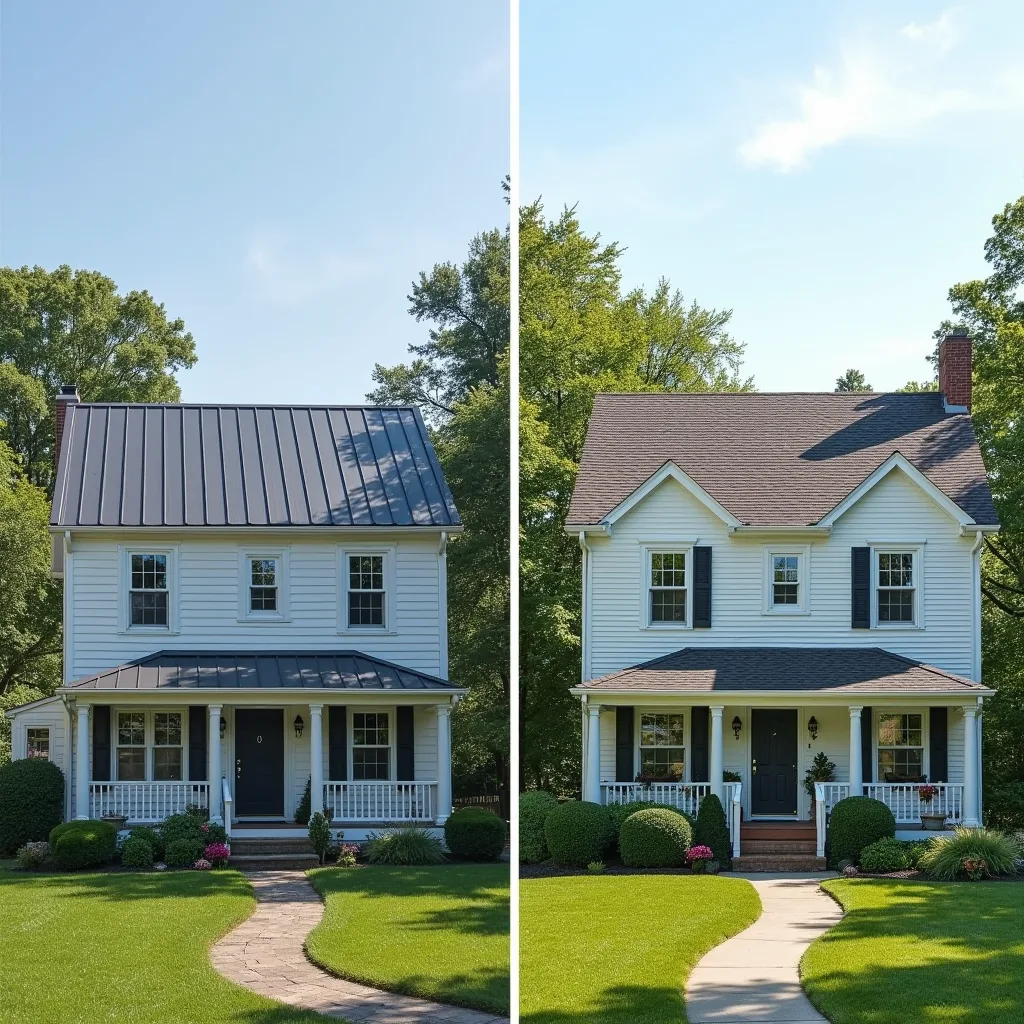
Metal roofing has a different visual character. Standing seam metal gives a modern, clean look that suits contemporary and farmhouse-style homes very well. Corrugated and exposed-fastener panels are more often used on agricultural or commercial buildings but are occasionally used on residential properties with a deliberate aesthetic. Metal shingles and stone-coated steel panels are a middle ground, designed to mimic the look of slate, tile, or wood shake while delivering the performance of metal.
If your neighborhood has an HOA or if your home is in a historic district, check the guidelines before choosing metal. Some HOAs have restrictions on roofing materials or colors that could affect your options.
If you want a closer look at what metal roofing actually looks like on local homes, our metal roofing page for Bucks County and this companion metal roofing resource include additional detail on styles and applications in this area.
Who YBR GROUP Inc Is and Why That Matters Here
YBR GROUP Inc is a locally owned roofing, siding, and window contractor based in the Bucks County area. The company serves homeowners across southeastern Pennsylvania, handling roof replacements, roof repairs, new siding, and window installation. Every job is scheduled directly with the owner, which means the person you speak with on the first call is the same person accountable for the work through the final walkthrough. There is no handoff to a project manager you have never met, no crew showing up without context, and no disconnect between what was promised and what gets done.
The team brings hands-on experience with both asphalt shingle and metal roofing systems on a wide range of residential properties across Bucks County and the surrounding area. That experience spans different home styles, roof pitches, structural conditions, and ventilation situations, the kinds of variables that look simple in a product brochure but get complicated on an actual house. The company also actively tracks qualifying criteria for energy rebate programs so homeowners can take advantage of available incentives without having to research it themselves.
You can also review roofing, siding, and windows services available in Norristown and nearby communities to see the full scope of work the team handles.
Side-by-Side Summary: Metal vs Asphalt for Pennsylvania Homes
Before getting into the FAQs, here is a plain-language comparison across the factors that matter most to most homeowners:
- Upfront cost: Asphalt shingles are far less expensive to purchase and install.
- Lifespan: Metal typically lasts two to three times longer than standard asphalt shingles.
- Energy performance: Metal, especially ENERGY STAR-rated products, reflects more heat. Some asphalt options also qualify.
- Maintenance: Metal requires less routine maintenance. Asphalt needs more frequent inspection and granule-loss monitoring.
- Durability in PA weather: Both perform well when properly installed and ventilated. Metal handles ice and hail somewhat better in most cases.
- Appearance: Asphalt fits most traditional neighborhood aesthetics. Metal is a strong fit for modern, farmhouse, or updated colonial styles.
- HOA compatibility: Always verify before choosing metal.
- Energy rebate eligibility: Both materials may qualify depending on the specific product. Verification before purchase is essential.
- Long-term ROI: Metal favors homeowners who stay 10 or more years. Asphalt favors those selling sooner or working within tighter budgets.
Talk to a Local Roofer Before You Decide
The right answer for your home depends on your roof deck, your budget, and how long you plan to stay. YBR GROUP installs both metal and asphalt roofs across Bucks County and southeastern Pennsylvania, and we will give you a straight comparison for your specific house, not a sales pitch. Call (267) 902-2393 or send the form below for a free estimate.
Call (267) 902-2393 For a Free Estimate
Frequently Asked Questions
Can metal roofing be installed over existing asphalt shingles in Pennsylvania?
In many cases, yes. Some metal roofing systems can be installed over one existing layer of asphalt shingles, which saves the cost of a tear-off. However, this is only appropriate if the underlying deck is in sound condition and if the added weight is within the structural limits of your home. A proper inspection before installation is required to make this determination. Local building codes also govern what is permitted, so it is worth confirming with your contractor before assuming this option is available.
Is metal roofing noisier than asphalt shingles during rain or hail?
This is one of the most common concerns homeowners raise, and the answer depends on how the metal is installed. On a residential home where metal is installed over solid decking and insulation, the noise difference compared to asphalt is minimal. The loud drumming sound people associate with metal roofs is typical of barns or structures where the metal is installed without underlayment or decking beneath it. A properly installed residential metal roof is not noticeably louder than asphalt during normal rain.
Does metal roofing increase the risk of lightning strikes?
No. Metal roofing does not attract lightning any more than asphalt shingles do. Lightning strikes the tallest point in an area regardless of what material covers it. Metal does not increase that risk. What metal does do, if struck, is conduct and disperse energy rather than combust, which actually makes it a safer material than wood or asphalt in a direct strike scenario.
Which roofing material qualifies for energy rebates in Pennsylvania in 2026?
As of 2026, there is no federal tax credit for roof replacement: the Energy Efficient Home Improvement Credit expired at the end of 2025, and roofing had already been removed from its qualified product list before that. Any current savings come from state, local, or utility programs, which depend on your utility and location and change periodically. The key is verifying what is actually available in your area before installation. YBR GROUP Inc helps homeowners work through this so nothing is missed.
How do I know which option is right for my Bucks County home?
The right answer depends on a combination of factors: your budget, how long you plan to stay in the home, the current condition of your roof deck and attic, the style of your home, and your energy goals. There is no single correct answer that applies to every house. The most useful step is a direct conversation with a contractor who has seen enough local roofs to give you honest guidance based on your specific situation, not a generic recommendation. YBR GROUP Inc schedules consultations directly with the owner, so you get that conversation from someone accountable for the outcome.
If you are ready to talk through your options for a roof replacement in Bucks County or the surrounding southeastern Pennsylvania area, contact YBR GROUP Inc directly. You will speak with the owner, get a straight answer about what your home needs, and find out exactly which energy rebates you may qualify for before any work begins. Reach out through ybrroofingsidingwindows.com to schedule your consultation.