You asked two siding contractors for quotes, and now two documents sit on your kitchen table. One is cheaper. One looks more detailed. Both promise a great looking house. The hard part is that two siding bids rarely describe the same job, so the totals alone tell you very little.
This guide shows you how to compare two siding contractor bids side by side, so you weigh like with like. It is written for homeowners in Bucks County and the surrounding Southeastern Pennsylvania area, where older homes, hard winters and a wide range of contractors make the choice harder than it looks. By the end you will have a checklist you can use with any two bids, from any company.
Call (267) 902-2393 for a Free Siding Quote
Why the Lowest Siding Bid Is Rarely the Whole Story
It is natural to look at the bottom line first. The trouble is that a siding bid is a bundle of decisions: which product, how much old material comes off, what goes on the wall underneath, how the corners and windows are finished, and who cleans up. A lower total can mean a smarter price, or it can mean something was left out.
Think of a bid as a recipe. If one recipe lists real butter and the other lists a substitute, you cannot compare the cost of the two cakes. Before you ask which siding bid is cheaper, ask whether both contractors are quoting the same house, the same materials and the same finished result.
If you are still deciding who to invite out in the first place, our guide on choosing a contractor in Bucks County, PA covers the early screening questions. This article picks up once you already have two bids in hand.
Step 1: Put Both Siding Bids on the Same Scope
The first job is to make the two bids describe the same project. Take a sheet of paper or a simple spreadsheet and make two columns, one for each contractor. Fill in the scope of work for each, line by line, using only what is written in the bid. If something is not written down, treat it as not included.
Scope Questions to Answer for Each Bid
- Which walls are included? The whole house, or only the front and sides? Are gables, dormers and the walls under porch roofs counted?
- What happens to the old siding? Is it removed completely, or is the new product going over it? Removal lets the installer see the wall underneath. Covering over it hides problems.
- Is disposal included? Hauling away old material is real work. Make sure it is listed.
- Are trim, soffit and fascia part of the job? Some bids quote only the wall siding and leave the pieces around it for a later conversation.
- What about windows and doors? The way siding meets a window opening decides whether water stays out. Look for how each bid describes the finish around openings.
When you find a gap in one bid, do not assume the contractor forgot. Ask, write the answer down, and ask for the bid to be updated in writing. A fair comparison needs both bids to cover the same ground.
Step 2: Compare Siding Materials Line by Line
Material is usually the biggest driver of price, and it is also where bids hide the most vagueness. A line that says “premium siding” or “quality vinyl” is not enough. You want the manufacturer, the product line, the thickness or profile where it applies, and the color.
Siding Type and Product Line
Vinyl, fiber cement and engineered wood each behave differently over time and cost differently to install. Manufacturers also sell several grades under one name, so two bids can both name a well known brand and still quote very different products. Write the exact product line in each column.
The material choice moves the price more than most homeowners expect. The JLC 2025 Cost vs. Value Report prices a 1,250 square foot siding replacement in the Philadelphia market at $17,785 for vinyl and $22,409 for fiber cement. At resale, fiber cement recouped 109.2 percent of its cost there and vinyl recouped 90.1 percent.
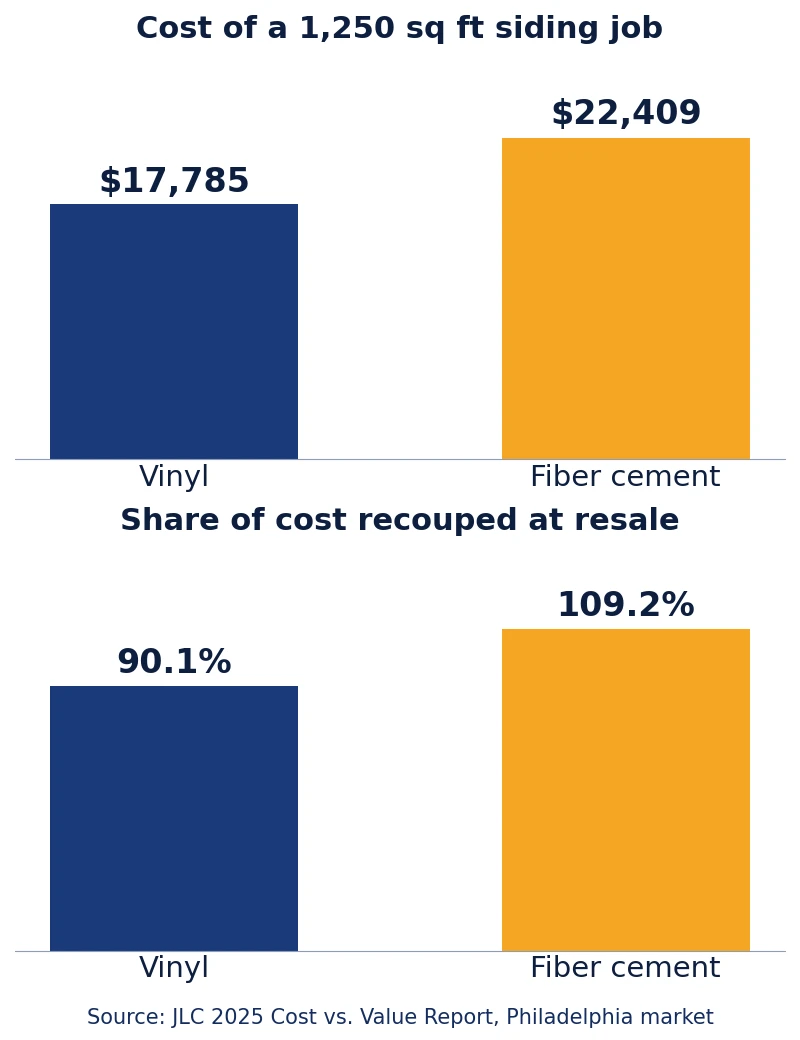
So if one bid quotes vinyl and the other quotes fiber cement, the gap between the totals may be the material, not the contractor. For the trade offs, read our comparison of James Hardie vs vinyl siding in Pennsylvania, and if a bid includes fiber cement, our page on James Hardie siding installation in Pennsylvania explains what that product requires.
Trim, Accessories and Color
- Trim and accessories: corner posts, J channel, window and door trim, and fasteners are part of the system. Ask what each bid uses.
- Color and finish: confirm the exact color name, and whether the finish is factory applied or painted on site. Our guide to vinyl siding colors and styles helps you name the color precisely.
Step 3: Look Closely at the Installation Details
Two crews can install the same siding and deliver very different results. The difference is in the layers and details you cannot see once the job is done, and those are the lines a short bid tends to skip.
The Layers Behind the Siding
- Water resistant barrier: the housewrap behind the siding that sheds water getting past the surface. Is it included, and which product is it?
- Flashing: the metal or membrane pieces that steer water away at windows, doors, rooflines and where walls meet decks. Missing or poorly placed flashing is a common source of trouble.
- Damaged sheathing or framing: when old siding comes off, soft wood sometimes shows up. Does the bid explain how that will be priced and approved?
Fastening, Spacing and Sealing
Siding needs room to expand and contract with temperature, so ask whether the crew follows the manufacturer’s installation instructions. Ask where caulk is used, which type, and where the crew deliberately leaves gaps for drainage. Our article on siding moisture problems shows what happens when water gets behind the wall.
A good question for both contractors is simple: “What are the three details on this job you would never skip?” The answers tell you a lot about how each team thinks.
Step 4: Read the Contract, Warranty and Payment Terms
Once scope and materials line up, move to the terms. This is where two bids with similar totals can turn out to be very different deals.
What Pennsylvania Law Requires in Writing
According to the Pennsylvania Office of Attorney General, the Home Improvement Consumer Protection Act requires home improvement contracts over $500 to be in writing and signed by both the homeowner and the contractor. The contract must include a description of the work, an approximate start and completion date, the total price, and notice of your right to cancel. The same law requires contractors to put their registration number on their ads and contracts.
The law also limits deposits on projects over $5,000. The Attorney General’s guidance says that, generally speaking, a down payment of one third of the total price, or one third plus the cost of special ordered materials, is appropriate. A siding bid that asks for most of the money before work begins fails that test.
Warranty, Change Orders and Schedule
- Workmanship warranty: separate from the manufacturer’s product warranty. Ask who stands behind the installation, for how long, and what is covered, in writing.
- Manufacturer warranty: ask whether the installation method affects it. Some product warranties depend on proper installation.
- Change orders: if the crew finds hidden damage, how is extra work priced and approved? A clear process protects both sides.
- Schedule and cleanup: does the bid state the expected start, how the site is kept, and daily cleanup?
If a term is missing from one bid, write “not stated” in that column. A blank is information too.
Step 5: Check the Contractor Behind Each Bid
A bid is a promise, and a promise is only as good as the company making it. After you compare the paperwork, compare the people.
- Registration and insurance: look up each contractor’s number on the state’s home improvement contractor search, and ask for a current certificate of insurance.
- Who you deal with: find out who manages your job after you sign.
- Local work: read reviews, ask for references, and look at finished homes near you.
- Crew: ask whether the installers are the company’s own team or subcontractors, and who is responsible on site.
- Communication: notice how quickly and clearly each contractor answers you now. That is usually a preview of how the job will go.
How YBR GROUP Inc Writes a Siding Quote
YBR GROUP Inc has served homeowners in Bucks County and Southeastern Pennsylvania since 2016, and handles siding, roofing and windows as one company. Our about page puts it plainly: one company from start to finish, no subs. Siding inspections and estimates are free, and same day quotes are often available. We are also glad to review a siding bid you received from another company and walk through it line by line with you.
YBR GROUP Inc is registered in Pennsylvania as PA099856 and carries $1,000,000 in general liability coverage. As one customer, Alex O., wrote in a March 2026 Google review: “The crew arrived exactly when scheduled and kept the project moving efficiently without delays.”
We work across the county, including Doylestown, Newtown, Yardley, Levittown and Warminster. For a wider view of the local market, see our Bucks County contractor guide.
Factor In Rebates, Then Make the Call
If your project also includes new windows, energy incentives can change what it really costs you. The rules changed recently: the IRS says the federal Energy Efficient Home Improvement Credit covers improvements made through December 31, 2025. Our PA energy rebates guide for Bucks County lays out what is still open, and the ENERGY STAR program is an independent place to compare window ratings. Ask each contractor whether the quote shows pricing before or after any incentive.
Your Final Side by Side Checklist
- Do both bids cover the same walls, materials and finishing pieces?
- Which bid explains the hidden work, such as the housewrap and flashing, more clearly?
- Which contract and warranty terms are written down, and which are only spoken?
- Does the deposit stay within what the Attorney General’s guidance describes?
- If the cheaper bid left something out, what would it cost to add it back?
Often the clearest winner is not the lowest price or the highest. It is the bid that is easiest to understand, from a contractor who answered every question plainly. To see what a well done job can do for a home, read about the benefits of upgrading exterior siding.
Frequently Asked Questions
Should I always choose the lowest siding bid?
No. The lowest bid may leave out removal of old siding, trim, flashing or repairs that another bid includes. Compare scope and materials first. If the lower bid truly covers the same work with the same products and terms, it may be good value. If not, the gap may close once the missing items are added.
How many siding bids should I collect?
Two or three detailed bids give you a useful comparison without becoming overwhelming. Each one needs the same careful reading, so it is better to compare a few detailed bids well than to skim many vague ones.
What if one siding bid is much more detailed than the other?
Ask the less detailed contractor to put the same information in writing: brand, product line, removal, housewrap, flashing, cleanup and warranty. If they will not, treat that as a warning. Detail in a bid usually reflects detail in the work.
How much deposit is normal for siding in Pennsylvania?
For home improvement projects over $5,000, the Pennsylvania Attorney General’s guidance says a down payment of one third of the total price, or one third plus the cost of special ordered materials, is generally appropriate. The contract must be in writing and include your right to cancel.
Will YBR GROUP Inc review a siding bid from another company?
Yes. Siding inspections and estimates are free, and we are glad to go through another company’s bid with you line by line. Call (267) 902-2393.
If you have two siding bids and want a second set of eyes, or you would like a clear written quote of your own, call YBR GROUP Inc at (267) 902-2393 or contact us online.