Most Bucks County homeowners don’t think about their roof until something goes wrong. Then comes the call to a contractor, the estimate, and the question that stops everyone cold: should I repair it or replace the whole thing?
It’s a real decision with real money attached. A repair might cost a few hundred dollars. A full roof replacement for Bucks County, PA homeowners typically runs into the thousands. But here’s what many people don’t consider: five repairs over five years can cost more than one replacement — and leave you with the same aging roof.
If your home was built or re-roofed in the 1980s or 1990s, you may already be past the point where repairs make financial sense. These seven signs will help you know the difference.
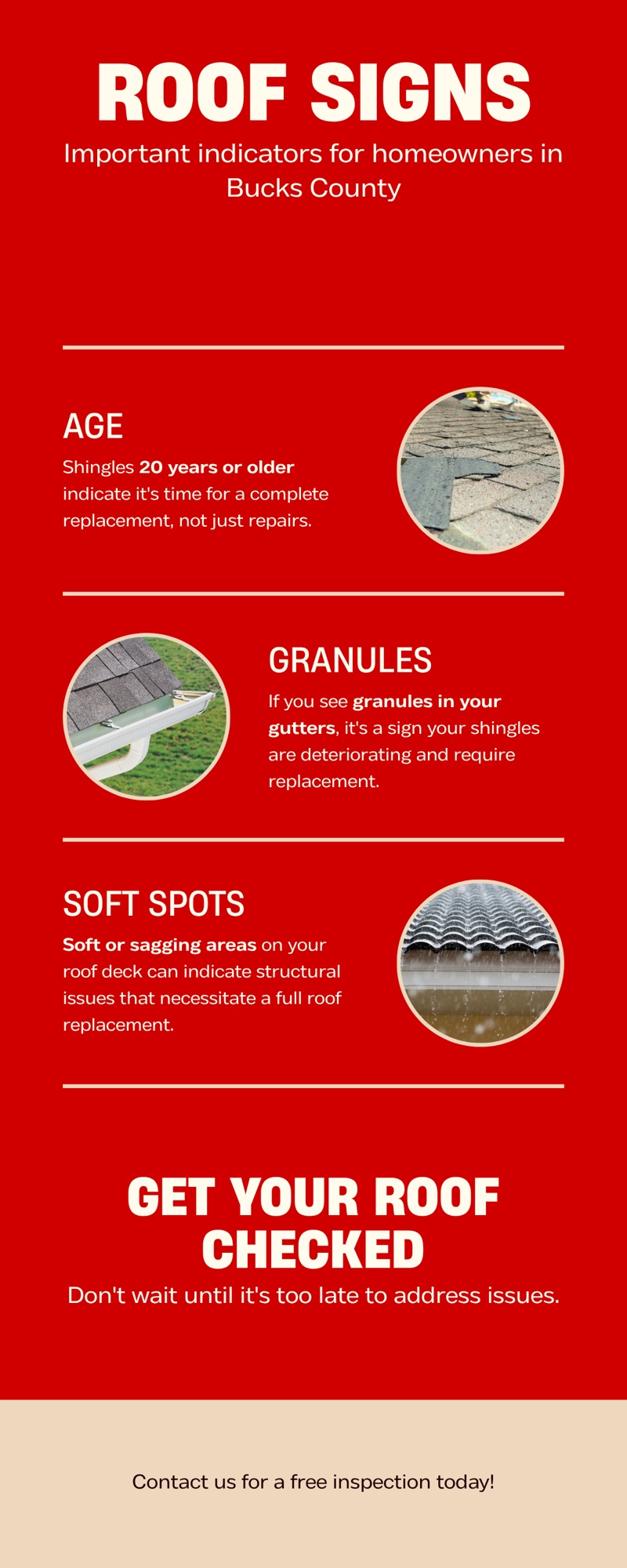
1. Your Shingles Are 20 or More Years Old
Asphalt shingles are the most common roofing material in Bucks County. They are durable, affordable, and widely available. Most three-tab asphalt shingles carry a 20-year rated lifespan. Architectural shingles can last 25 to 30 years under normal conditions.
If your roof is in that age range, repairs may extend the life by a few years — but the underlying material is degraded. You’re patching an old foundation. A full roof replacement gives you 25 to 50 years of protection depending on the material you choose.
2. You’re Finding Granules in Your Gutters
Asphalt shingles are coated with mineral granules. Those granules do two things: they protect the shingle from UV radiation, and they shed water efficiently off the roof surface.
When you clean your gutters and find a buildup of dark, sand-like granules, the shingles are shedding their protective coating. This accelerates deterioration. Isolated granule loss near a chimney or valley can sometimes be repaired. Widespread granule loss across the entire roof surface is a replacement indicator, not a repair one.
3. The Roof Deck Has Soft Spots or Is Sagging
Walk your attic when conditions are safe. Look for areas where the roof deck — the plywood or OSB sheathing beneath the shingles — feels soft or spongy underfoot. Look for visible bowing between rafters from inside.
A sagging roof deck means moisture has compromised the structural layer beneath your shingles. At this point, you’re not just replacing surface material. You’re replacing the substrate. That’s a full replacement job, and it should not wait.
4. You’ve Had Ice Dam Damage
Bucks County winters run hard from December through March. Freeze-thaw cycles are common — temperatures rise during the day, drop below freezing at night, and the cycle repeats dozens of times across a season.
Ice dams form when heat escapes from the attic and melts snow at the roof’s center. That water runs down to the cold eave, refreezes, and backs up under the shingles. The result is water intrusion along the roofline, staining on ceilings, and degraded flashing. If you’ve had repeated ice dam damage, the shingles along your eaves may already be compromised beyond repair. Proper attic insulation and a new roof work together to stop the cycle.
5. You Can See Daylight Through the Attic Boards
Go into your attic on a bright day. Turn off the lights. If you can see pinpoints or streaks of daylight coming through the roof boards, water can get through too.
Small gaps near ridge vents or at flashing seams can sometimes be sealed. But if daylight is visible in multiple places — especially along the field of the roof — you’re looking at systemic failure. That’s a replacement conversation, not a repair estimate.
6. Flashing Is Failing in Multiple Locations
Roof flashing is the metal material — typically galvanized steel or aluminum — installed around chimneys, skylights, vents, and roof valleys. Its job is to seal transitions between the roof surface and vertical structures where water would otherwise enter.
A single failed flashing can often be replaced. When flashing failures are showing up in three, four, or five locations on the same roof, the underlying issue is usually age and movement of the roof deck beneath. Replacing individual pieces of flashing on a deteriorated roof is temporary work at best.
7. Your Energy Bills Have Been Climbing
A roof in poor condition affects your home’s thermal envelope. Compromised shingles, failing underlayment, and inadequate attic ventilation all allow conditioned air to escape in winter and radiant heat to enter in summer.
If your heating and cooling bills have increased noticeably over the past two or three years without a change in energy rates or usage habits, your roof and attic system may be a contributor. A replacement that includes proper ventilation and modern underlayment can reduce energy loss and bring those costs back down.
The Bottom Line: When Repairs Stop Making Sense
Repairs are the right call when the damage is isolated, the roof is under 15 years old, and the overall structure is sound. When multiple signs from this list apply to your home, you’re spending repair money to delay an inevitable replacement — and in the meantime, you’re exposed to water damage, structural issues, and rising energy costs.
YBR GROUP Inc has served Bucks County homeowners since 2016. We offer free, no-obligation roof inspections so you can make this decision with accurate information — not guesswork.
Call us at (267) 902-2393 or visit our Bucks County roofing services page to schedule your inspection. We work throughout Bucks County, PA and surrounding areas in PA, NJ, and DE. If your inspection leads to a siding conversation too — common on 20+ year homes — see our guide: James Hardie vs. Vinyl Siding for Pennsylvania Homes.